
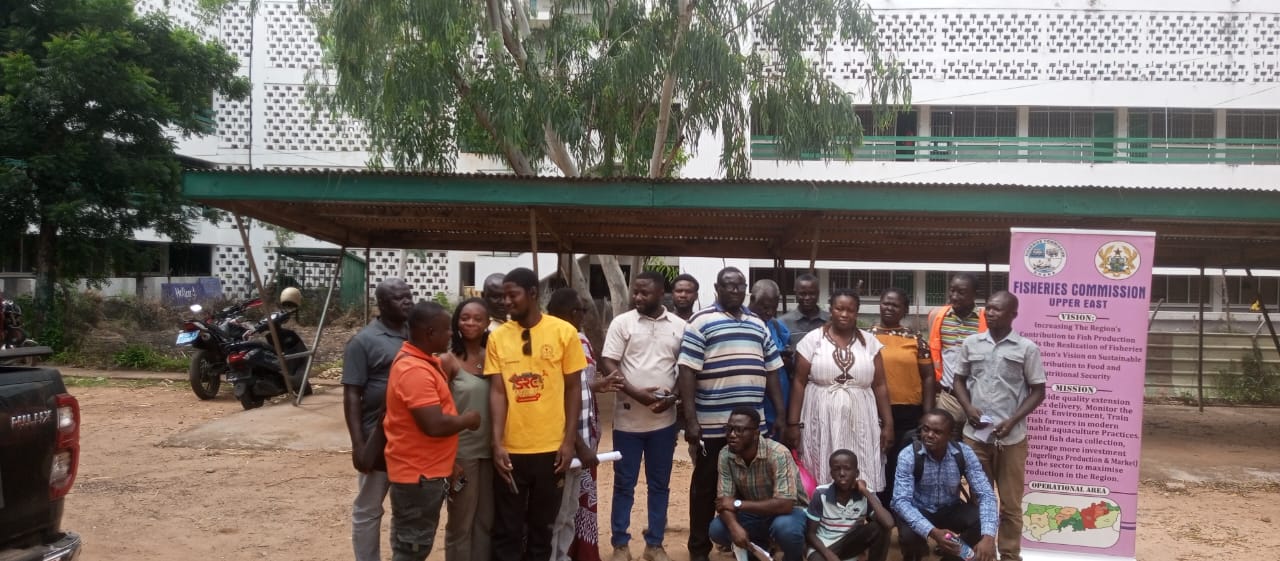
The Fisheries Commission is training selected fish farmers and stakeholders in the Upper East Region to produce Black Soldier Fly larvae as an alternative protein source for fish feed, an intervention aimed at reducing production costs for aquaculture farmers.
The Upper East Regional Directorate of the Commission says locally producing the larvae could provide farmers with a cheaper and more sustainable alternative to conventional fishmeal while also providing high-quality protein for fish.
The initiative formed part of a two-day Training of Trainers workshop held at the Fisheries Commission’s regional office in Bolgatanga on August 11 and 12, 2026.
Upper East Regional Director of the Fisheries Commission, Sarah Bachon-Ene Mwinibuobu Bamie, said participants were trained to rear, harvest, process and use Black Soldier Fly larvae in aquaculture.
“The training aimed at equipping participants with practical knowledge and skills in BSF larvae production, promoting the use of BSF larvae as a sustainable and cost-effective alternative protein source in aquaculture,” she said.
According to Madam Bamie, the larvae can be used as live feed for fish or processed as a protein ingredient in formulated fish feed.
The Commission expects participants to transfer the knowledge and skills acquired during the workshop to fish farmers within their respective areas.
Madam Bamie said wider adoption of the technology could enable farmers to locally produce high-quality protein ingredients and reduce their expenditure on fish feed.
Participants were drawn from selected fish farms across four zones covering the Talensi, Nabdam and Bongo districts, as well as the Bolgatanga and Kassena-Nankana municipalities.
Representatives of stakeholder institutions, including the Environmental Protection Authority and the Upper East Regional Coordinating Council, also participated.
The first day of the workshop focused on the biology and life cycle of the Black Soldier Fly, site selection, facility requirements, substrate preparation, feeding regimes and techniques for rearing, harvesting and processing the larvae.
Participants were also introduced to the use of Black Soldier Fly larvae as fish feed and as an ingredient in feed formulation, as well as the potential economic and environmental benefits of the technology.
The second day shifted from theory to practical production.
Participants learned how to set up a “love cage” for adult Black Soldier Flies, prepare suitable feed or substrate for the larvae and establish nests for egg collection.
The Commission said the practical component was intended to give participants the skills required to establish their own production systems and subsequently train other farmers.
Participants who spoke after the workshop described the training as timely, saying the use of Black Soldier Fly larvae could reduce their dependence on conventional feed ingredients and lower production costs.
The Fisheries Commission expects the trainers to take the knowledge back to their respective communities, with the broader goal of expanding the use of locally produced feed ingredients and promoting more sustainable aquaculture across the Upper East Region.
A1 Radio | 101.1 MHz | David Azure | Bolgatanga