
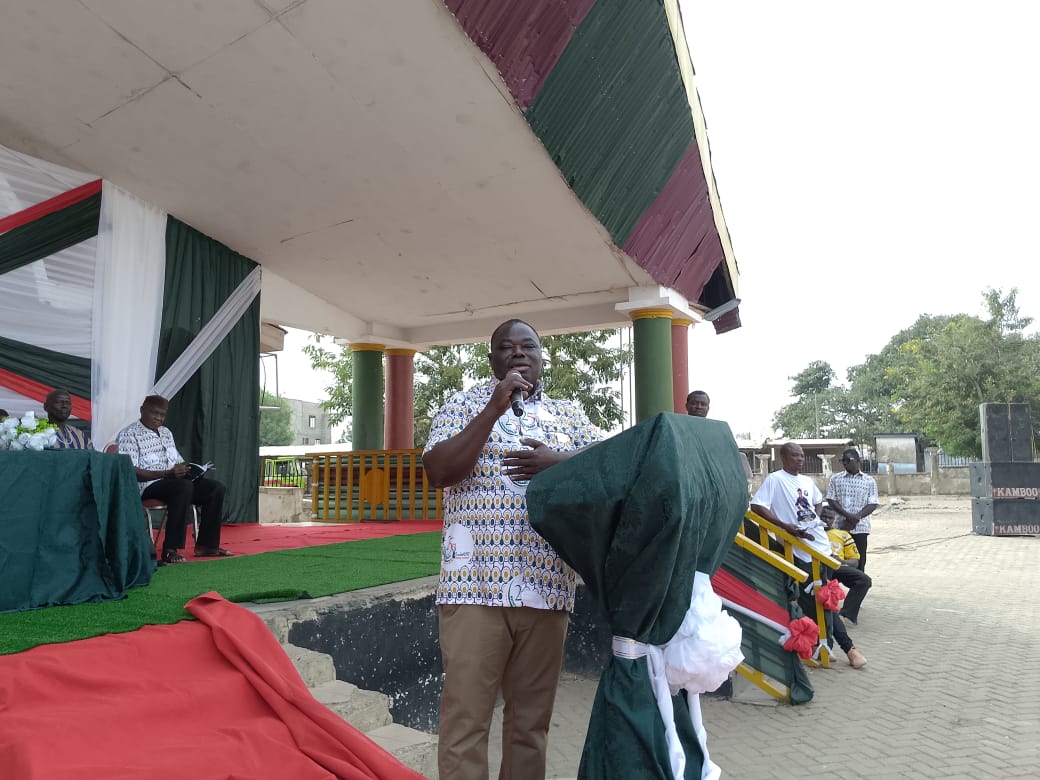
TradeAid Integrated has renewed its commitment to tackling poverty and promoting entrepreneurship in the Upper East Region as it celebrated its 25th anniversary at the Jubilee Park in Bolgatanga. The event brought together donors, partners, community groups and artisans from across the region, highlighting the organisation’s long-standing work in livelihood empowerment, climate resilience and social accountability.
Speaking at the ceremony, Executive Director Nicholas Apokerah acknowledged the development partners whose support has sustained TradeAid’s interventions over the years. He highlighted the foundational role of Oxfam GB, which funded the organisation’s earliest basket-weaving initiatives, and commended long-term partners such as Canadian Feed the Children, SMV, IFDC and the Star-Ghana Foundation for consistently supporting programmes in food security, climate change adaptation and community empowerment.
He said the strong community turnout reflected the deep local ownership of TradeAid’s work. According to him, the organisation’s projects in basket weaving, agriculture, climate-smart farming, anti-corruption advocacy and livelihood development have succeeded largely because of the commitment shown by beneficiary communities.
“Our work around basket, our work around food security, our work around climate change, our work around advocacy, anti-corruption, and all that is well articulated by the presence of these community members that you see here today,” he said. “I want to appreciate them for finding time to be with us today.”
Mr. Apokerah also expressed concern about rising poverty levels in the Upper East Region. Recent data from the Ghana Living Standards Survey shows multidimensional poverty in the region stands at about 24.8 percent—significantly higher than the national average of 10 to 12 percent. “I also want to say that this is not the end of TradeAid. We are going to work further because we know that poverty in the Upper East Region has actually increased,” he added.
He explained that earlier gains were eroded by the effects of COVID-19 and global economic shocks, pushing many households back into vulnerability. Addressing poverty, he said, requires a stronger focus on entrepreneurship—an approach that has powered economic transformation in Western countries. TradeAid Integrated believes enabling young people, farmers and artisans to build sustainable enterprises is key to improving education, healthcare, housing and food security in the region.
“We believe that the best way to address poverty is to get people to be entrepreneurs… once we can get our people to be entrepreneurs, we’ll work and then reduce the poverty that we are confronted with,” he said.
Looking ahead, the organisation plans to scale up entrepreneurship training, youth empowerment and climate-smart agriculture over the next five years. Mr. Apokerah also underscored the need to address illegal mining and ensure gold-rich communities in the Upper East Region do not fall into the environmental and social crises seen in parts of southern Ghana. He called for collaboration with partners to develop responsible mining strategies while advancing rural livelihoods.
“In the specific case of the Upper East Region, we need to look at how to get the gold mining communities to not fall into the same trap that the southern communities are put in,” he said.
The anniversary was celebrated alongside the Bolgatanga International Craft and Arts Festival (BICAF) 2025 and was chaired by the Bolgatanga Chairperson of the Ghana National Association of Teachers (GNAT), Solomon George Gbenga, under the theme “25 Years of Transforming, Advancing Livelihoods and Building Resilience.”
Source: A1 Radio | 101.1Mhz | Gifty Eyram Kudiabor | Bolgatanga