
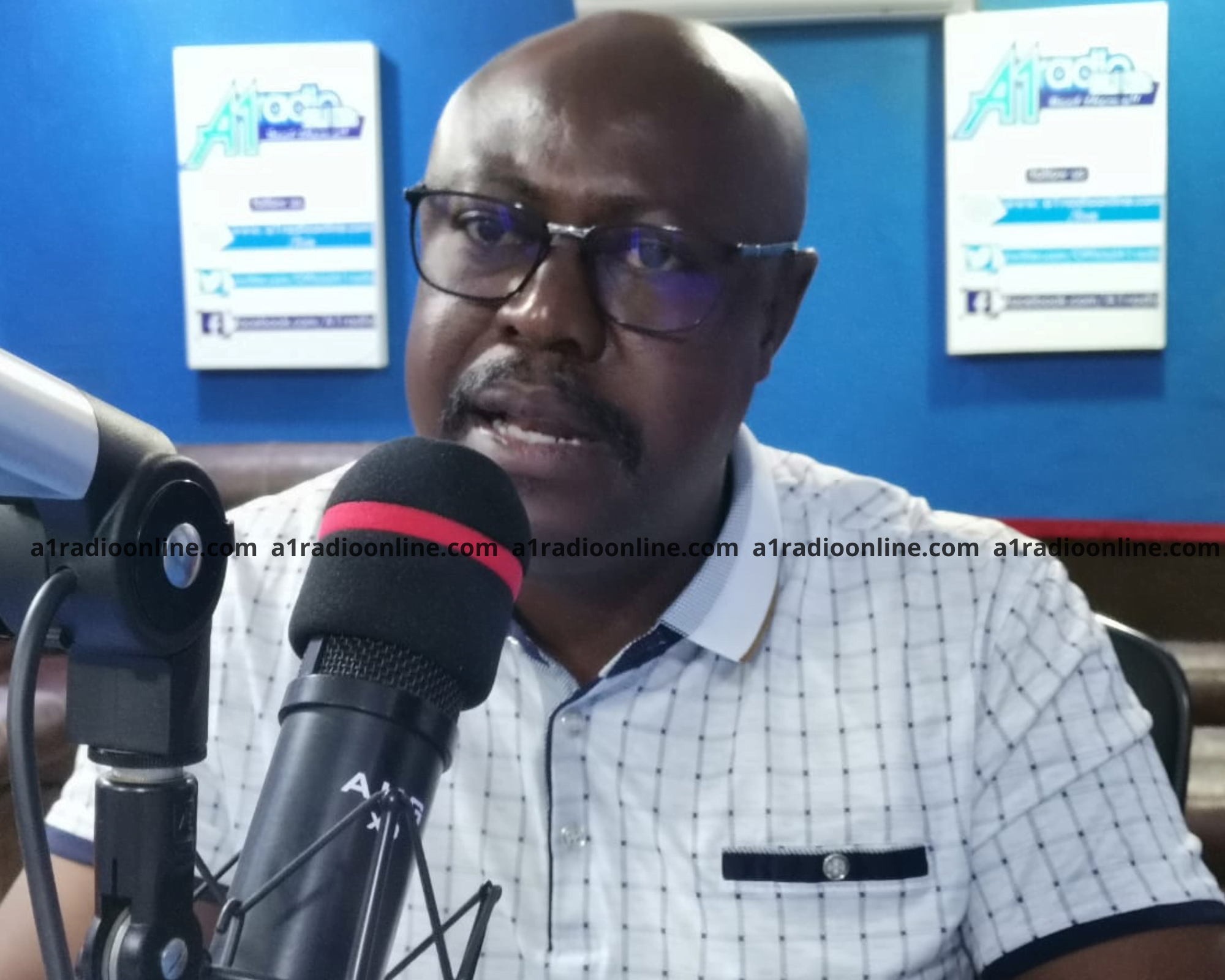
A development expert and Senior Lecturer at the University of Technology and Applied Sciences (UTAS), Professor Mohammed Sumaila Asaah, has lamented the gradual decline of major irrigation infrastructure in the Upper East Region, warning that the region is failing to harness its enormous agricultural potential.
Speaking on Daybreak Upper East on A1 Radio on Wednesday, March 11, 2026, Prof. Asaah said the region has the capacity to become a major food production hub for Northern Ghana if facilities such as the Vea Dam and Tono Dam are properly revitalised and managed.
According to him, the irrigation schemes were originally designed not only for crop production but also for large-scale fish farming.
“Vea was constructed to support crops, vegetables and fish production, but since its creation we have not produced any meaningful fish from the dam,” he said.
Prof. Asaah insisted that the two dams alone have the potential to supply fish to the entire northern part of the country if investments are directed into aquaculture.
“Vea and Tono together have the capacity to produce enough fish to feed the whole of Northern Ghana and even beyond. I have personally verified this and even attempted to mobilise investment into the Vea Dam with a colleague, but unfortunately it did not materialise,” he revealed.
The development expert disclosed that more than 25 earthen ponds built around the Vea irrigation scheme for fish production have now been abandoned or converted into rice fields.
“These earthen ponds were ideal for producing large volumes of fish. Today many of them are silted and have been turned into rice farms, even though they can easily be rehabilitated,” he said.
He noted that a similar situation exists at the Tono irrigation scheme, where several aquaculture facilities remain underutilised despite their enormous potential.
“Now you see the Prison Service and a few private individuals trying commercial aquaculture there, but when you look at the bigger picture you have to ask yourself: have we progressed or have we moved backwards?” he questioned.
Prof. Asaah further warned that the region’s irrigation agriculture is gradually ageing as young people abandon farming due to poor market opportunities.
“If you go to Vea today, most of the farmers you will see are old men and old women. You go to Tono and it is the same situation,” he said.
He added that more than 25 percent of the irrigation potential at Tono alone remains unexploited.
“The Upper East actually has the comparative advantage when it comes to irrigation farming in Northern Ghana. We have the human resource and the commitment, yet the sector is dying,” he observed.
Prof. Asaah attributed the growing disinterest among young people to the lack of reliable markets for agricultural produce.
“Every young person wants the energy he puts into work to reflect in what he earns. But you produce tomatoes or pepper and there is no market. That discourages them,” he explained.
He suggested that investment in processing and storage facilities could help stabilise markets and prevent post-harvest losses.
“Why can’t we process pepper into paste? Why can’t we build solar-powered warehouses to store produce or process them? These are practical solutions that can transform agriculture in the region,” he proposed.
Prof. Asaah cited the IWAD irrigation project in Yagba as an example of modern agricultural investment that could inspire development in the Upper East Region.
“At IWAD they have solar-powered pivot irrigation systems where a single rig can cover over 200 acres of land, and one person controls it with a computer,” he said.
He stressed that similar investments at the Vea Dam and Tono Dam could transform agricultural production and create sustainable jobs for young people.
Prof. Asaah also questioned why existing agro-processing facilities such as the Pwalugu Tomato Factory remain idle despite the region’s large tomato and pepper production.
“We used to process tomatoes at the Pwalugu factory. Why is it still lying there unused?” he asked.
He therefore called on political leaders and investors to prioritise strategic agricultural investments in the region to unlock its economic potential.
“The young people of the Upper East do not deserve what is happening. God has blessed this region with enormous resources,” he said.
“We must look politicians in the face and tell them the truth: the Upper East has been blessed, but the opportunities are not being fully utilised.”
A1 Radio | 101.1 Mhz | Seidu Mutawakil | Bolgatanga