
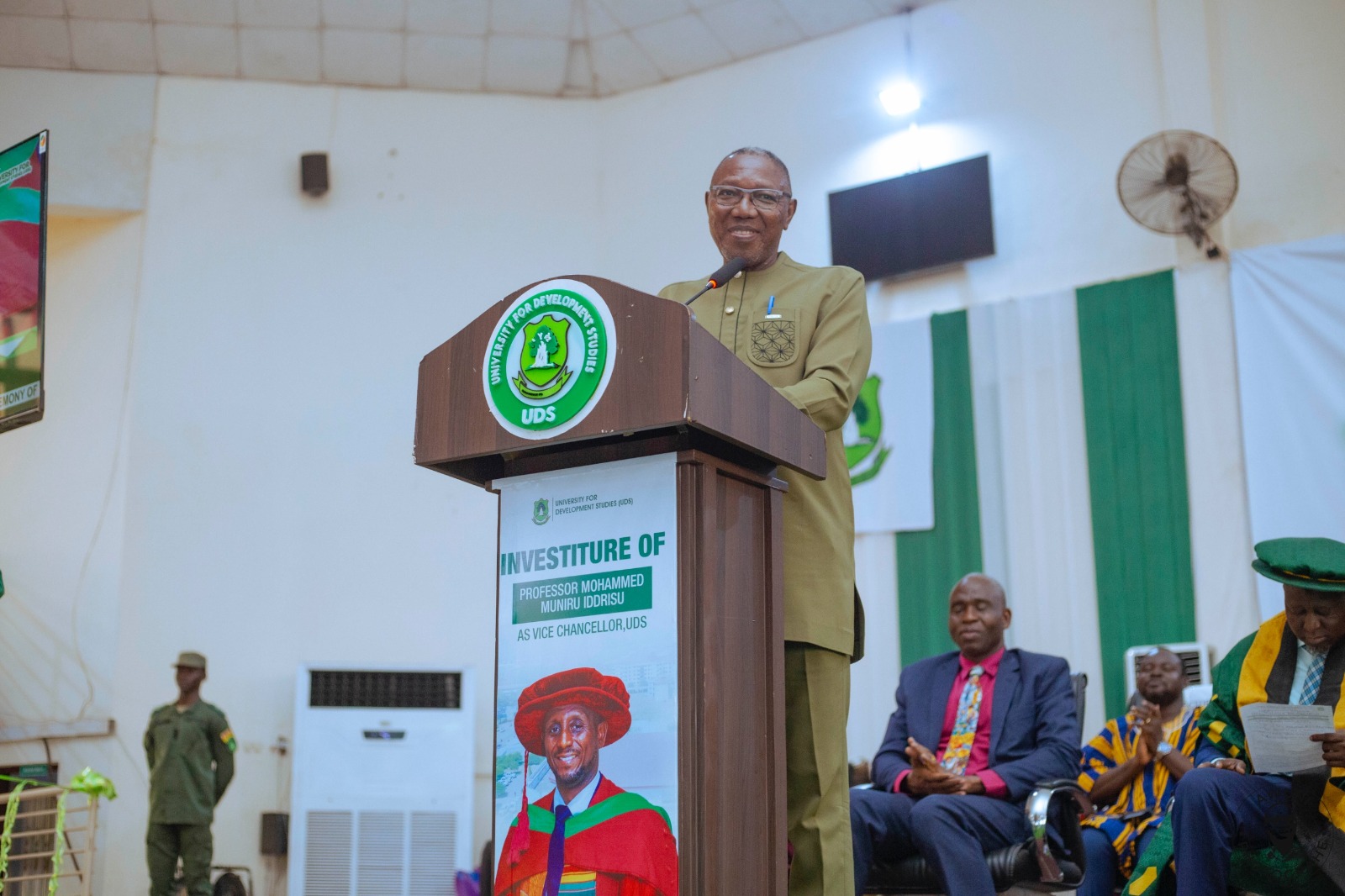
Deputy Minister for Education Dr. Clement Abas Apaak has tasked the new Vice-Chancellor of the University for Development Studies (UDS), Professor Mohammed Muniru Iddrisu, to tackle student accommodation, water shortages, inadequate learning facilities and graduate unemployment as he takes charge of the university.
Dr. Apaak said Professor Iddrisu assumes leadership at a time when Ghana’s universities are grappling with growing student numbers, inadequate and unpredictable funding, ageing infrastructure and a rapidly changing job market.
He made the remarks at the investiture of Professor Iddrisu as the sixth Vice-Chancellor of UDS at the university’s Tamale Campus on Thursday, September 3, 2026.
Dr. Apaak said UDS’s development mandate requires the university to ensure its teaching and research respond directly to problems confronting communities, particularly in northern Ghana.
“UDS must continue to be a university that sees the farmer, the rural woman, the unemployed graduate, the community without safe water, the child threatened by malnutrition and the settlement exposed to climate change as part of its academic responsibility,” he said.
Student welfare cannot be peripheral
The Deputy Minister said concerns about accommodation, water supply, roads and learning facilities could no longer be treated as peripheral to the university’s academic mission because they directly affect students’ ability to learn.
“A student who spends valuable time searching for water, struggling to secure safe accommodation or navigating an unsafe learning environment cannot participate fully in academic life,” he said.
He called on the new administration to prioritise safe accommodation, reliable water, secure learning facilities, counselling and a supportive academic environment.
Graduate unemployment and AI
Dr. Apaak also identified graduate unemployment, limited research funding and inadequate opportunities for continuous staff development as challenges requiring attention.
While the government continues to expand access to tertiary education, he cautioned that increasing enrolment should not come at the expense of academic standards.
“Access without quality offers only the appearance of progress,” he said.
The Deputy Minister also urged UDS to prepare students and staff for the rapid growth of artificial intelligence and other digital technologies, which he said are transforming teaching, research, knowledge production and the nature of work.
He called for investment in digital infrastructure, human capacity and ethical standards to enable the university to adopt new technologies without compromising academic integrity.
Research must improve lives
Dr. Apaak challenged UDS to strengthen research in agriculture, climate change, food security, public health, renewable energy, water management, peacebuilding, education and digital technology.
He said university research should not end with academic journals and conferences but should influence government policy, district development plans and activities in businesses, farms, clinics and communities.
“A university does not fulfil its mandate merely by producing knowledge. It fulfils that mandate when knowledge improves lives,” he said.
He therefore urged UDS to deepen partnerships with government, industry, development partners, traditional authorities, communities and international institutions.
Revive community-based learning
Dr. Apaak also called for the modernisation of UDS’s Third Trimester Field Practical Programme while preserving its community-development focus.
He said students participating in the programme should enter communities not merely to satisfy an academic requirement but as learners, partners and problem-solvers.
According to him, the programme should expose students to real-life challenges including climate vulnerability, public health, local governance, entrepreneurship and digital exclusion.
Call for accountable leadership
Turning to the administration of the university, Dr. Apaak urged Professor Iddrisu to prioritise transparency, prudent financial management, staff and student welfare, fair disciplinary processes and constructive engagement with organised labour.
He also called for greater gender inclusion and support for persons with disabilities, saying every member of the university community should be able to learn and work with dignity.
The Deputy Minister urged the new Vice-Chancellor to build consensus and listen to stakeholders, including those who may not have easy access to his office.
“Leadership is not proved by how firmly one occupies a chair. It is proved by how responsibly one carries the weight of the institution,” he said.
Dr. Apaak assured UDS that the Ministry of Education would continue working with the university’s Governing Council, management and other stakeholders to advance its mandate.
Professor Iddrisu was subsequently invested as the sixth Vice-Chancellor of UDS, succeeding Professor Seidu Al-hassan.
A1 Radio | 101.1 MHz | Moses Apiah | Bolgatanga