
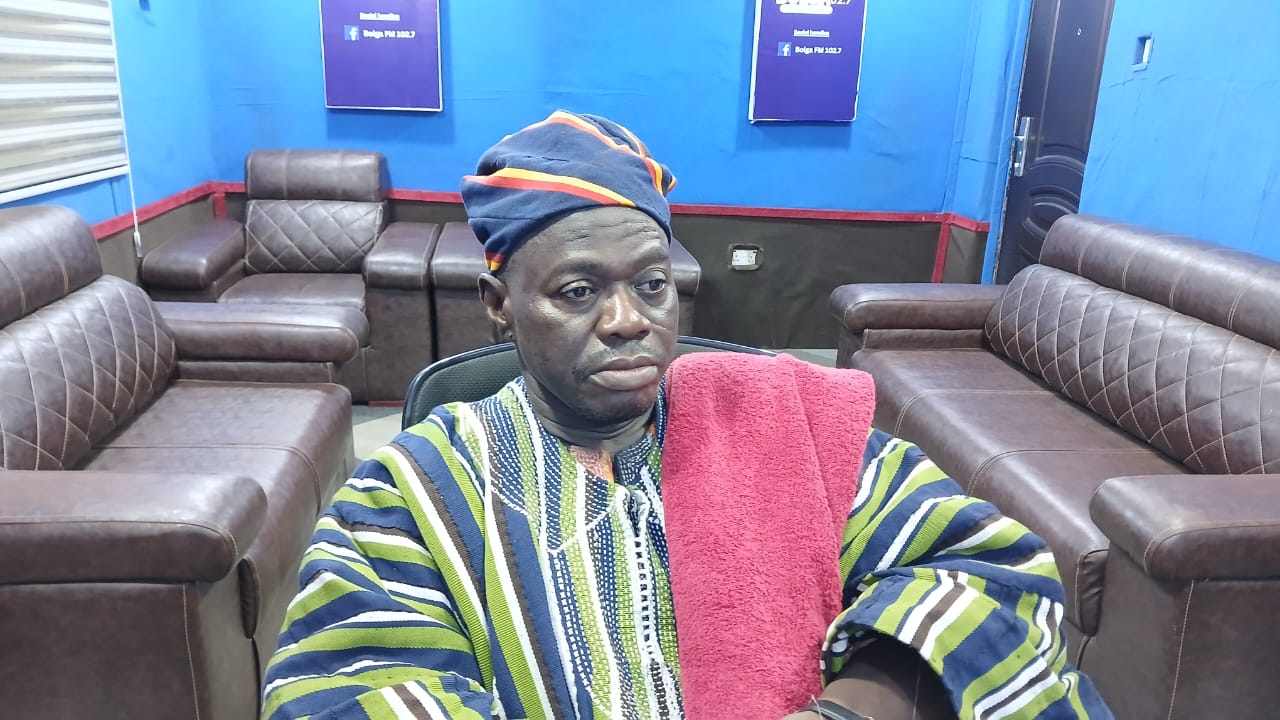
Naab Bileehsing Lanwont Namoog of the Kotintabig Traditional Area under the Sakoti Traditional Council in the Nabdam District has called for reforms to the Upper East Region’s traditional leadership system, arguing that its fragmented nature makes it difficult for chiefs to speak with a united voice on the region’s development.
Speaking on Bolga FM’s Tooma La Dengo Sanga, Naab Bileehsing said the traditional system should create opportunities for qualified and capable divisional chiefs to advance to paramountcy while maintaining respect for existing traditional authorities.
“Our chieftaincy has a problem. The fragmented chieftaincy that we have in the region is the problem causing all that. We are fragmented,” he said.
He questioned why some paramount chiefs preside over large numbers of divisional chiefs when, in his view, some of those traditional areas could be elevated.
“Why would one paramount chief preside over thirty-two divisional chiefs? Why? How will we grow? How will we grow? That is not the way we should go,” he said.
Naab Bileehsing said some divisional chiefs have strong educational and professional backgrounds, including PhDs, and could contribute to deliberations and administration at the Regional House of Chiefs if given the opportunity.
He argued that creating additional traditional areas should not be viewed as diminishing the authority of existing paramount chiefs, but as an opportunity to broaden representation and potentially attract more development.
“If you elevate me, I am not coming to take [your authority]. The thing is that I will still honour you as the one, the senior authority,” he said.
Using the allocation of development projects as an example, Naab Bileehsing argued that the creation of additional traditional areas could potentially increase the number of communities benefiting from projects.
“Assume I am elevated to the paramountcy status, Sakoti is given three schools to be built. I will also be given three schools to be built. Is it not development?” he asked.
He also expressed concern that, unlike what he described as more centralised traditional leadership structures in the Northern and Upper West regions, the Upper East has several distinct traditional authorities without a single institution capable of mobilising chiefs around regional concerns.
He cited the Ya-Na in the Northern Region and Wa Naa in the Upper West Region as examples of traditional authorities that, in his view, can provide greater coordination on matters affecting their respective regions.
Naab Bileehsing linked the need for greater unity to the region’s political representation, questioning why the Upper East has not recorded the level of growth in parliamentary constituencies he believes has occurred elsewhere.
He recalled that before the former Upper Region was divided into the Upper East and Upper West regions, the area had 28 parliamentary constituencies, which he said were distributed between the areas that later became the two regions.
He argued that the Upper East has since seen comparatively limited growth in its parliamentary representation and attributed this, in part, to what he described as the region’s inability to collectively advocate for its interests.
Naab Bileehsing therefore called for stronger cooperation among traditional leaders and other stakeholders, while advocating reforms that would allow capable chiefs to progress within the traditional leadership system.
He maintained that such reforms should preserve respect for established traditional authorities while creating broader representation and a stronger collective voice for the development of the Upper East Region.
A1 Radio | 101.1 MHz | Moses Anaba Azubire | Bolgatanga