
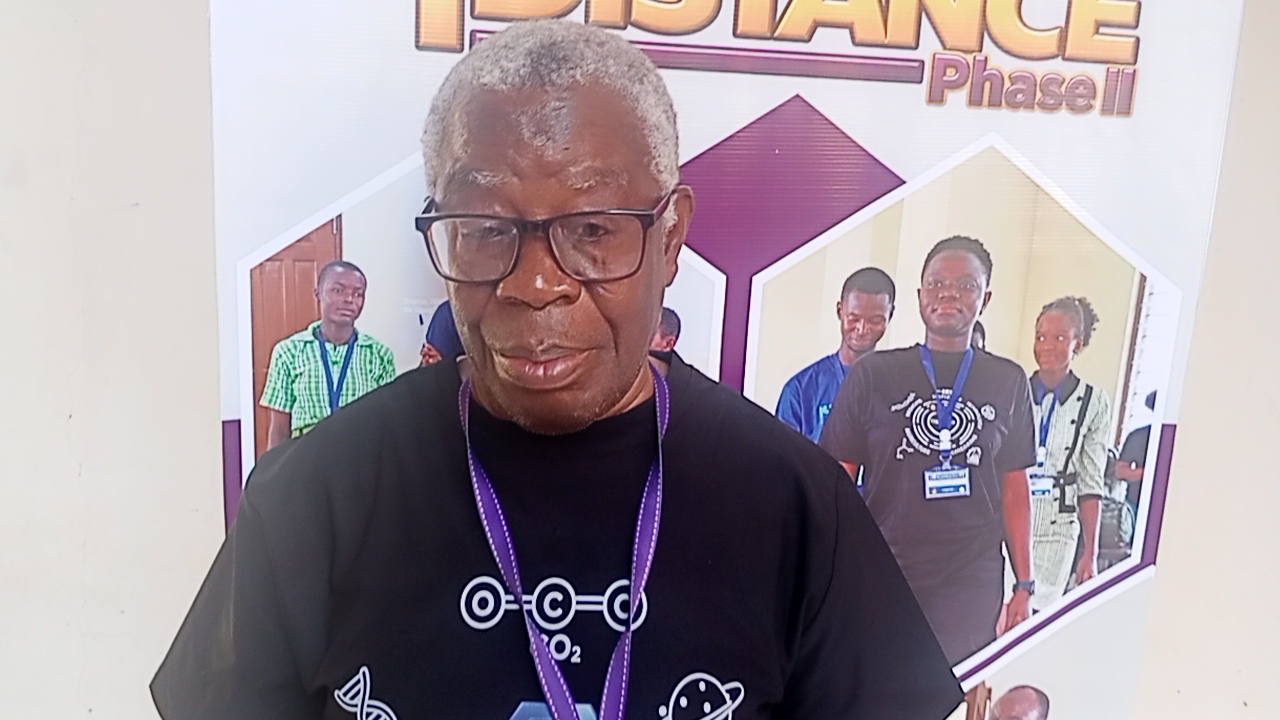
Professor Johannes Akpabla Mawuli Awudza of the Kwame Nkrumah University of Science and Technology (KNUST) has raised concerns about inequalities in access to practical science education in Ghana, warning that students in poorly resourced public schools are being expected to compete with their counterparts in better-equipped private schools despite significant differences in learning conditions.
He said many public schools, particularly those in deprived communities, lack basic laboratory facilities and materials needed for practical science lessons, leaving students at a disadvantage when writing national examinations and seeking admission to higher educational institutions.
Prof. Awudza raised the concerns during a practical science training programme for teachers at Gambibgo Community Day School in the Upper East Region.
According to him, while some private and international schools have the resources to provide students with regular practical lessons, many public schools struggle to obtain even basic materials for scientific experiments.
He described the disparity as unfair, particularly because students from both categories of schools are assessed through the same examination system.
“We have these two categories of students, and all of them have to write the same examination. Apart from writing the same examination, all of them have to progress into higher education,” he said.
Prof. Awudza questioned how students in deprived schools could be expected to compete fairly when they lack opportunities to develop the practical skills and understanding required for science education.
He said the situation was particularly concerning in underserved communities in Northern and Western Ghana, where inadequate facilities and teaching resources continue to affect science education.
The KNUST lecturer therefore urged the Ghana Education Service and other education stakeholders to prioritise the provision of basic laboratory equipment and teaching materials to improve practical science education in public schools.
He, however, maintained that effective practical science teaching did not always require expensive laboratory equipment.
According to him, teachers could use affordable and locally available materials to demonstrate scientific concepts and conduct experiments that would improve students’ understanding of science.
“We have told them what to do. We have done experiments that are practical. We do not need much money,” he said.
He encouraged science teachers to adopt innovative teaching methods while calling on education authorities to ensure that schools have the basic resources required for effective teaching and learning.
Beyond the challenges facing science education, Prof. Awudza also called for increased investment in educational infrastructure, learning materials and teacher welfare, describing education as essential to Ghana’s development.
“Without education, our minds would be shut. Without education, our people would draw back to the ancient times,” he said.
He acknowledged government investments in school infrastructure, including the construction of Community Day Senior High Schools, commonly known as E-Blocks, but said providing buildings alone was insufficient to guarantee quality education.
According to him, schools must also be equipped with the necessary learning materials and supported by teachers who are adequately motivated to deliver effective lessons.
Prof. Awudza expressed concern about disruptions to teaching and learning resulting from teacher absence, recounting an encounter at a school where he found a student studying alone in the library.
“It is sad that you come to a school like this, with the facilities that they have provided, and teachers are not in the classroom,” he said.
He consequently urged the government and teacher unions to engage in constructive dialogue to resolve outstanding concerns affecting teachers and minimise disruptions to academic activities.
The professor also called for stronger collaboration between government and local communities in the management of educational facilities.
He said communities should take greater responsibility for protecting and maintaining school infrastructure provided in their areas to ensure that such investments continue to benefit learners.
Prof. Awudza maintained that improving educational outcomes would require sustained attention to infrastructure, practical learning resources, teacher welfare and community participation.
A1 Radio | 101.1 MHz | Moses Anaba Azubire | Bolgatanga