
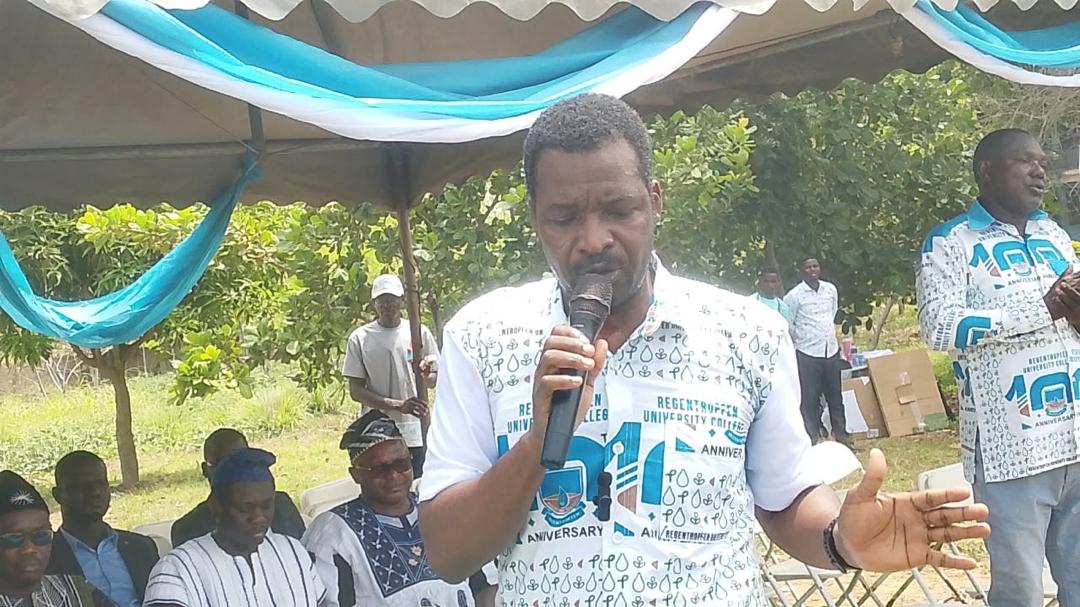
The Founder and President of Regentropfen University College, Rev. Fr. Dr Moses Asaah Awinongya, has defended the decision to establish a university in rural Namoo in the Bongo District of the Upper East Region, arguing that access to quality higher education should not depend on where a student lives.
He said the institution was established to address inequalities in access to tertiary education, particularly for young people in rural communities who face financial and geographical barriers to pursuing university education.
Speaking as Regentropfen University College marked its 10th anniversary, Rev. Fr. Dr Awinongya said the decision to locate the institution outside a major urban centre had raised questions about its economic viability.
However, he maintained that the university’s purpose was to develop the potential of young people rather than maximise financial returns.
“Many asked me at the beginning of the University College and some still do today, whether establishing a University College in a rural area made/make business sense. My answer was and is simple: YES. The young people will create wealth for Ghana. We are promoting talents. We are not maximizing profit,” he said.
According to him, many young people in the Upper East Region previously had to travel to southern Ghana to pursue higher education, a situation that placed additional financial pressure on students and their families.
He argued that students from rural communities deserved access to the same educational opportunities available to their counterparts in urban areas.
Reflecting on the institution’s early years, Rev. Fr. Dr Awinongya acknowledged that establishing a university college in Namoo came with significant challenges.
He identified inadequate accommodation for staff and students, poor road access, limited infrastructure and low student enrolment as some of the difficulties the institution encountered.
“We had more faith than facilities and more vision than funding,” he said.
Despite those challenges, he said the institution continued to operate with support from the University for Development Studies, staff, students, traditional authorities, parents, alumni, academic partners and other benefactors.
Rev. Fr. Dr Awinongya disclosed that Regentropfen initially received accreditation to offer 10 academic programmes, comprising five diploma and five bachelor’s degree programmes.
Over the past decade, the institution has expanded its offerings to five diploma programmes, 10 undergraduate degree programmes and three postgraduate programmes.
He said additional programmes had been submitted to the Ghana Tertiary Education Commission (GTEC) for accreditation as part of efforts to broaden educational opportunities.
Beyond expanding access to higher education, the President said Regentropfen was committed to producing graduates capable of identifying problems, developing solutions and creating employment opportunities.
He argued that universities should prepare students to contribute to economic development through innovation and entrepreneurship rather than focusing solely on securing salaried employment.
Looking ahead, Rev. Fr. Dr Awinongya said the institution intended to expand postgraduate education and research, strengthen partnerships with industry and international organisations, and pursue a charter to operate as an autonomous university.
He also outlined plans to introduce a medical programme supported by a proposed hospital within the next five to ten years, subject to the necessary preparations and regulatory approvals.
The university President appealed to individuals, organisations and development partners to support the institution’s efforts to extend higher education to underserved communities.
Regentropfen University College is celebrating its 10th anniversary under the theme, “From Vision to Reality: A Decade of Promoting Talents and Shaping Future Minds.”
A1 Radio | 101.1 MHz | Moses Apiah | Bongo