
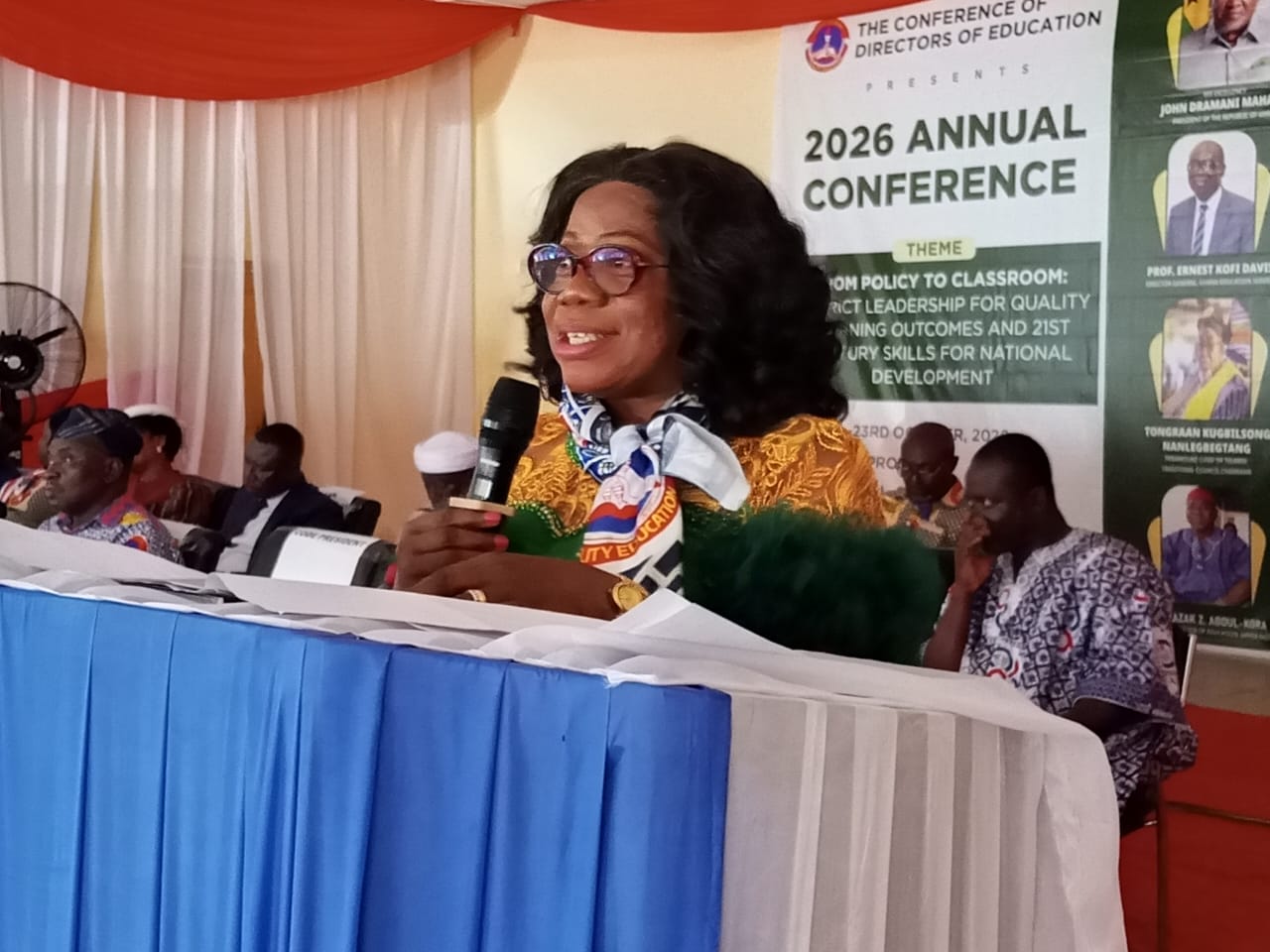
According to him, the success of national education policies depends largely on how effectively district education leaders translate those policies into meaningful improvements in classrooms.
His remarks were delivered on his behalf by Professor Smile Gavua Dzisi at the 33rd Annual Conference of Directors of Education (CODE), held in Bolgatanga in the Upper East Region.
Addressing participants, Prof. Dzisi emphasised that education policies developed at the national level would achieve little without effective implementation and supervision at the district and school levels.
“The theme chosen speaks the truth. We must never forget the distance between a good policy and a good lesson is walked by people. Policies may be written in Accra. Lessons are taught in Bawku, Zebilla, and Garu. Between the two, that is the policy and lesson, stands our hard-working district directors of education. You are the hinge on which the door of national policy swings opens to the classroom,” she stated.
She explained that curriculum reforms and other education policies would remain ineffective unless teachers received the necessary support, learners had access to textbooks and schools benefited from regular supervision.
“District leadership is not a minor matter at all. It is the habit of implementation. When a district lives well, schools function better, teachers teach with greater confidence, and children learn more happily. When a district drifts, the child pays the price,” she added.
The GES Director-General, through his representative, urged education directors to adopt a supportive approach to school supervision, ensuring that every visit helped teachers improve their instructional methods and headteachers strengthen school management.
He stressed that improving learning outcomes must begin with foundational skills, particularly reading, writing and numeracy.
“Our responsibility is not simply to count the children in school, but to ensure that the children in the school are learning,” she said.
The conference was held under the theme, “From Policy to Classroom: District Leadership for Quality Learning Outcomes and 21st Century Skills for National Development.”
Meanwhile, the Upper East Regional Minister, Donatus Akamugri Atanga, who also addressed the conference, urged education directors to prioritise measurable improvements in teaching and learning rather than focusing solely on the implementation of administrative policies.
“The success of education policy is not determined by what is written in the policy document alone, but by what happens in our classrooms. Your leadership must therefore be visible in effective supervision, teacher performance, responsible resource management, and measurable improvements,” he stated.
Mr Atanga described education as an important pathway out of poverty and a means of reducing inequality in the Upper East Region.
He therefore called for equitable teacher deployment, adequate teaching and learning materials, and greater support for girls and children with disabilities to ensure that no learner was left behind.
The Regional Minister also expressed concern about what he described as declining discipline and moral standards in schools, urging education authorities and other stakeholders to address the situation.
He called for stronger collaboration among the Ghana Education Service, district assemblies, traditional authorities, parents and development partners to improve education delivery across the region.
A1 Radio | 101.1MHz | David Azure | Bolgatanga