
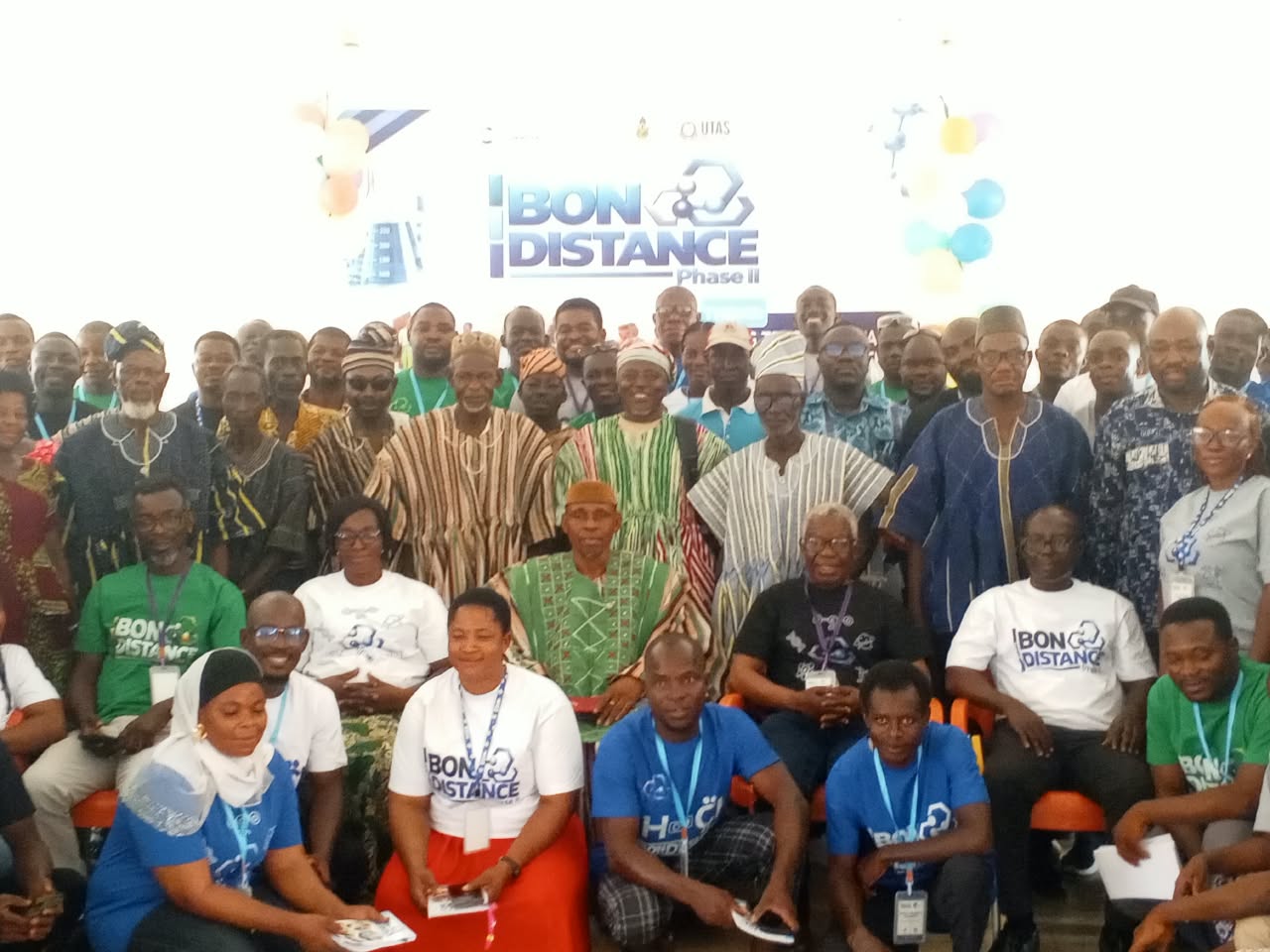
Seventy-three Junior High School (JHS) science teachers from the Bolgatanga Municipality and Bolga East District have received practical chemistry training to improve science teaching in schools, particularly those without laboratories.
The two-day training, held from October 5 to 6, 2026, at Gambibgo Community Day Senior High School in the Bolga East District, brought together one teacher from each of the 73 junior high schools across the two areas.
Of the participants, 54 were drawn from the Bolgatanga Municipality, while 19 came from the Bolga East District.
The training formed part of the BONDISTANCE Phase II project, funded by the Royal Society of Chemistry (RSC) through its Chemists’ Community Fund, under the theme, “Scaling Teacher Capacity in Practical Chemistry.”
Participants were introduced to hands-on chemistry experiments using locally available materials, as well as PhET interactive simulations to help students understand scientific concepts through virtual demonstrations.
The initiative particularly targeted teachers without formal science training, those who had never conducted practical chemistry experiments and teachers working in schools without laboratory facilities.
Speaking at the opening ceremony, the Lead Programme Coordinator and Senior Lecturer at the Department of Chemistry of the Kwame Nkrumah University of Science and Technology (KNUST), Dr Gershon Amenuvor, said the training was developed in response to concerns raised by teachers during an earlier project in 2023.
He explained that the first phase of BONDISTANCE, also supported by the Royal Society of Chemistry, provided practical chemistry learning opportunities for 180 young learners in the Gambibgo community.
However, feedback from teachers revealed that some were teaching scientific experiments they had never personally conducted.
“We have never done these practicals before. We have been teaching what we have never seen,” Dr Amenuvor quoted some of the teachers as saying.
He said the revelation prompted the then Bolga East District Director of Education, George Asirah, and the Chief of Gambibgo to request a follow-up programme specifically targeting teachers.
According to him, the request informed the development of BONDISTANCE Phase II, which seeks to equip teachers with practical skills and affordable teaching methods that can be applied even in schools without conventional laboratories.
Dr Amenuvor stressed that the programme was not limited to improving teachers’ knowledge of chemistry but was also intended to strengthen their confidence in delivering practical science lessons.
“It is about telling every teacher here: You matter. Your work matters. And you are not alone,” he said.
He expressed appreciation to the Royal Society of Chemistry, Ghana Chemical Society, University of Technology and Applied Sciences (UTAS), Navrongo, and KNUST’s Department of Chemistry for supporting the initiative.
The Secretary of the Ghana Chemical Society, Dr Michael Baah Mensah, also called for greater investment in practical science education, stressing that every child deserved access to quality chemistry education regardless of geographical location or background.
He said equipping teachers with the necessary skills, knowledge and confidence was essential to making science education more accessible and inclusive.
Dr Mensah, however, acknowledged that sustaining such programmes required financial and technical support, particularly for teacher training, laboratory equipment, learning materials and community outreach.
He appealed to industry players, institutions, development partners and individuals to support practical science education initiatives through funding, equipment, mentorship and technical expertise.
“Investing in teachers today is investing in the next generation of scientists and innovators,” he said.
The Chief of the Gambibgo Traditional Area, Naba Sayeed Akolmolga Anon-Egra Sadik, commended the organisers and participating teachers for their commitment to improving science education.
He urged teachers to apply the knowledge and practical skills acquired during the training to improve students’ understanding of chemistry and stimulate greater interest in science.
The chief also called for the programme to be sustained rather than treated as a one-time intervention.
According to him, strengthening science and technology education was necessary to prepare Ghanaian and African youth to compete in an increasingly technology-driven world.
He argued that while Africa must preserve its history and learn from past achievements, greater attention should be given to developing the scientific knowledge and technological capabilities needed for future development.
Naba Sayeed therefore called for sustained investment in science education and stronger collaboration among educational institutions, professional bodies and development partners.
The organisers expressed optimism that the training would help teachers introduce more practical lessons in their classrooms and encourage students to pursue further studies and careers in science, technology, engineering and mathematics.
A1 Radio | 101.1 MHz | Moses Anaba Azubire | Bolgatanga