
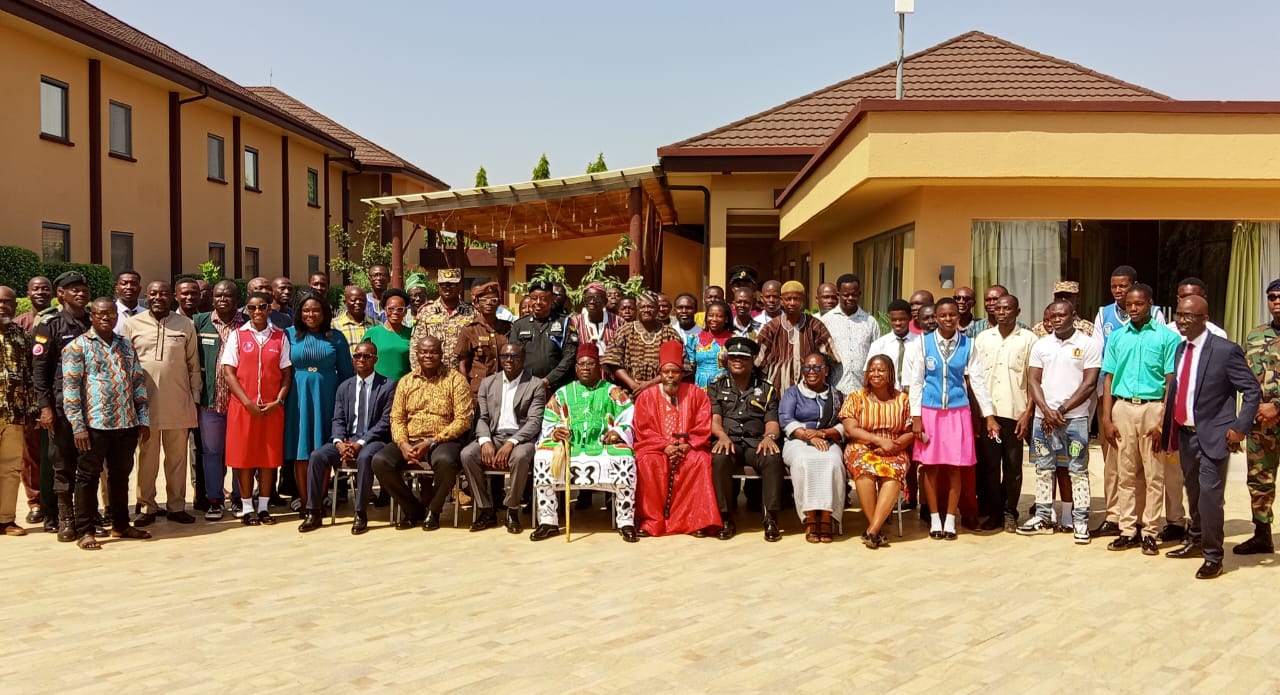
The National Security Council Secretariat (NSCS) has begun a nationwide review of Ghana’s 2020 National Security Strategy, seeking input from stakeholders in the Upper East Region on emerging security threats, including communal conflicts, mining-related tensions, organised crime and youth vulnerability.
The review is intended to assess the implementation of the existing strategy, identify emerging security risks and develop a revised framework to strengthen national security.
As part of the process, the Secretariat organised a regional stakeholder engagement in Bolgatanga, bringing together representatives of security agencies, civil society organisations, youth groups, traditional authorities, the media and other stakeholders.
Speaking at the forum, the Technical Aide to the National Security Coordinator, Dr Mohammed Bako, explained that the review was both a policy necessity and a statutory requirement.
He said Ghana introduced its first National Security Strategy in 2020 to provide a coordinated framework for addressing threats to the state and its citizens.
According to him, the Security and Intelligence Agencies Act, 2020 (Act 1030), required the strategy to be reviewed within two years of the inauguration of a new Parliament.
However, the Security and Intelligence Agencies Act, 2026 (Act 1168), which repealed Act 1030, has shortened the review period to one year.
“In Ghana, however, the review of the 2020 NSS is not only a matter of good policy practice; it is also a statutory requirement,” Dr Bako stated.
He explained that the Secretariat, acting under the authority of the National Security Council and in accordance with Act 1168, had initiated a comprehensive review of the strategy.
Dr Bako said stakeholder engagements would be held across all 16 regions to gather local perspectives on security threats, vulnerabilities and emerging concerns.
He noted that the participation of residents of the Upper East Region was particularly important because of the region’s strategic location and unique security challenges.
Speaking on behalf of the Upper East Regional Minister, the Regional Coordinating Director, Bless Kwame Darkey, welcomed the consultation, describing it as an opportunity for local communities to contribute to the country’s security framework.
“The review provides an opportunity to assess the implementation of the existing strategy, examine emerging security threats and contribute practical recommendations towards strengthening our national security architecture,” he said.
Mr Darkey identified communal and boundary disputes, mining-related tensions, drug and substance abuse, organised crime and youth vulnerability among the security concerns requiring attention in the region.
“For us in the Upper East Region, security remains fundamental to peace, social cohesion and sustainable development,” he stated.
He called for a coordinated and preventive approach to addressing these challenges, stressing that responsibility for maintaining security extended beyond state security agencies.
“Security is not the responsibility of security agencies alone. It is a shared responsibility,” he said.
According to him, effective security management requires the participation of government institutions, traditional and religious authorities, civil society organisations, political parties, the private sector, academia, the media and local communities.
Mr Darkey also urged policymakers to consider the socioeconomic conditions that contribute to insecurity, particularly unemployment, exclusion and vulnerability among young people.
He encouraged participants to move beyond identifying security threats and propose practical measures to address them.
“Our objective should not merely be to identify threats but also to propose realistic responses, clarify institutional responsibilities and strengthen collaboration among relevant stakeholders,” he said.
Mr Darkey reaffirmed the commitment of the Upper East Regional Coordinating Council to collaborate with the National Security Council Secretariat, the Regional Security Council and other stakeholders to promote peace, stability and development in the region.
A1 Radio | 101.1 MHz | David Azure | Bolgatanga