
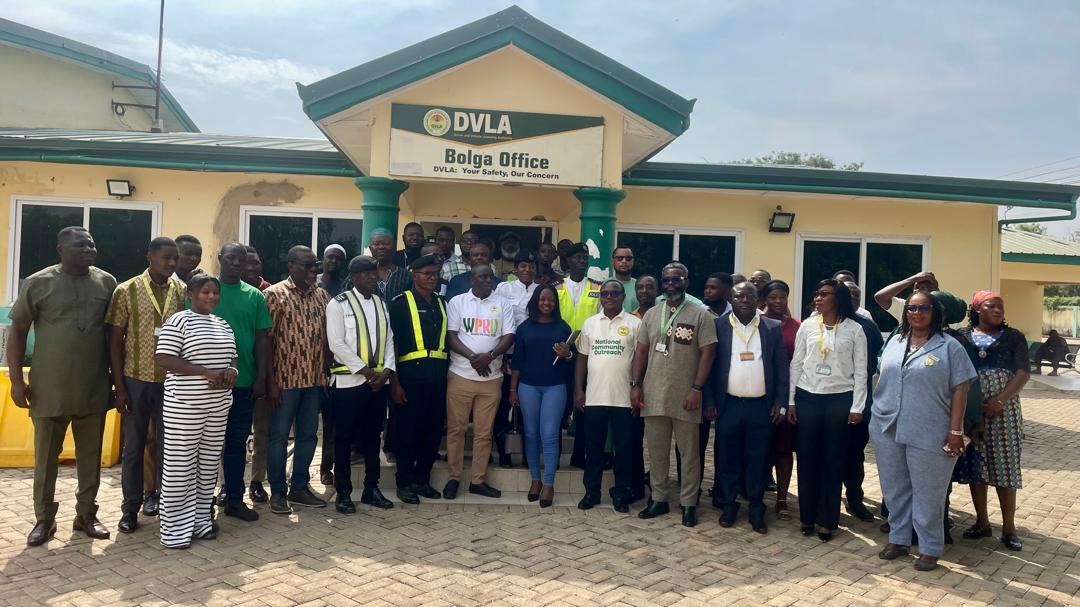
The Driver and Vehicle Licensing Authority (DVLA) has begun sensitizing key stakeholders in the Upper East Region on major reforms to the vehicle registration number plate system, scheduled to take effect from January 2026. The engagement, held at the Regional Office in Zuarungu, brought together representatives from the National Road Safety Authority, the Motor Traffic and Transport Department (MTTD), Customs, DVLA staff, motorbike dealers, GPRTU, and the media.
Speaking to journalists after the session, Kafui Semevor, Director of Driver Training, Testing and Licensing at the DVLA, said the exercise marks the beginning of a nationwide effort to educate the public on the upcoming changes.

He explained that the new number plate system is designed to address long-standing challenges with the existing database, which currently makes it difficult for authorities to accurately identify vehicles on the road.
“There are situations where we are unable to properly identify some vehicles because the database is not up to date. This affects enforcement and compromises the integrity of the registration process,” he said.
The DVLA’s reforms will introduce smart number plates embedded with RFID chips, which will allow for seamless identification and more effective law enforcement. Mr. Semevor noted that the new plates will be embossed exclusively by the DVLA, ending the current practice where third-party embossment centers produce plates without proper authorization.
“People have walked into fitting shops and produced plates without the knowledge of the Authority. Some even assign numbers to vehicles that should not be on the road. This will no longer be possible under the new system,” he said.
He added that the DVLA will verify and activate each plate before it is affixed to a vehicle to ensure that all registered vehicles are captured in the national database.
Clarifying how the transition will be implemented, Mr. Semevor stated that the reforms will begin with new vehicles on the first working day of January 2026. “By June 2026, we will start recalling already registered vehicles for re-registration,” he disclosed, assuring the public that the process will be carried out in a convenient and customer-friendly manner.
Multiple outlets will be opened to avoid congestion, and vehicle owners will be able to access the service on request.
Mr. Semevor acknowledged that unauthorized plates have contributed to revenue losses and posed significant security risks in recent years. “Once a vehicle carries a plate not issued by the state, that is direct revenue loss and a compromise to public safety,” he noted.
He confirmed that some unapproved plates have been used in criminal activities, making it difficult for authorities to track offenders because the corresponding records do not match the vehicles in question.
“This reform will give us an updated and reliable database that enhances enforcement and improves national security,” he emphasized.
The Upper East engagement marks the start of a broader sensitization campaign that will continue until 2027. Regional DVLA offices will replicate the discussions with transport unions, private sector operators, and the general public to ensure that all stakeholders understand the reforms.
Mr. Semevor stressed that the DVLA remains committed to strengthening Ghana’s vehicle registration system and ensuring that the transition to the new number plates is smooth, transparent, and beneficial to national security and public safety.
Source: A1Radioonline.com|101.1Mhz|Joshua Asaah|Zuarungu