
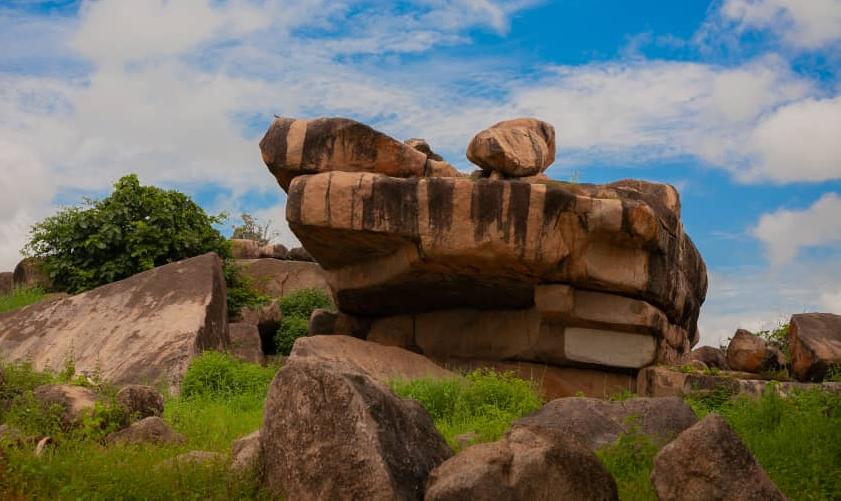
At the Pikworo Slave and Heritage Camp, on the outskirts of Paga near the Burkina Faso border, a tour guide named Aaron Azumah sometimes waits the entire day without a single visitor. During school excursion season, as many as a thousand students might pass through in two weeks. Then silence again.
“We feel abandoned,” Azumah says. “People who come here from the south, when they finish, they confess our place is neglected. The needed attention is not coming.”
The contrast with the rest of Ghana is not subtle. At Wli Waterfalls in the Volta Region, queues form daily. Cape Coast Castle anchors international heritage tourism circuits, diaspora homecoming programmes, and school curricula. The Ashanti Region has built an entire tourism economy around its royal identity, its festivals, its museums, and the living storytelling tradition that draws both Ghanaians and foreign visitors year after year.
Meanwhile, in the Upper East, a region stacked with crocodile ponds, slave-era heritage, ancient shrines, and craft villages producing some of the world’s finest hand-woven baskets, the sector limps along, hollowed out by bureaucratic neglect, political indifference, and a near-total failure of coordination among the very people responsible for it.
The story of tourism in the Upper East is not a story of missing assets. It is a story of squandered ones.
The Numbers Tell Two Stories
Official data from the Ghana Tourism Authority’s Upper East regional office reveals a recovery that is both striking and lopsided.
The COVID-19 pandemic effectively erased 2020 from the record books, no visitors, no data, no accountability. The damage bled deep into 2021. SWOPA, the craft and cultural tourism centre in Sirigu, which had generated GH₵ 119,976.50 in 2019, collapsed to just GH₵ 2,559 in 2021. Pikworo hit rock bottom that same year. Tongo Hills and the Tengzug Shrine, which had recorded GH₵ 18,800 with 1,830 arrivals in 2019, fell to GH₵ 6,216 with just 560 visitors in 2021. Across the board, a sector that had been fragile even before the pandemic was left badly exposed.
Then, something unexpected happened. The bounce-back was explosive.
By 2022, Pikworo had generated GH₵ 247,278.50 from 3,857 arrivals, a figure that announced, unmistakably, that appetite for the region’s heritage had not disappeared. SWOPA went further, rocketing from GH₵ 308,212.10 in 2022 to an all-time high of GH₵ 509,778.50 in 2024, fueled by high-value visitor spending and what appears to be a growing, if still underserved, interest in authentic cultural experiences. The Zenga Crocodile Pond recorded an unprecedented 11,239 arrivals in 2024, bringing in GH₵ 41,980. The Tongo Hills and Tengzug Shrine climbed back to GH₵ 11,182 in 2022 and has continued to grow. The Chief Crocodile Pond in Paga followed a similar trajectory.
The second story those numbers tell is harder to explain, and harder still to defend.
Despite this recovery, the Kassena-Nankana West District Assembly, whose territory contains both the Paga Crocodile Pond and Pikworo, reported receiving exactly GH₵ 0.00 in tourism revenue. Zero. Not a fraction of the hundreds of thousands generated within its borders reaches its coffers. An official Right to Information response from the Assembly confirmed what insiders had long suspected: the local government is entirely locked out of the financial windfall its own infrastructure helps to sustain.
Between 2022 and 2026, the Assembly allocated GH₵ 440,000 to its tourism budget. This included GH₵ 86,000 for a ten-seater toilet facility at the Paga Crocodile Pond in 2025, a smaller GH₵ 2,167 for a urinal in 2021, and more than GH₵ 55,000 poured into local cultural festivals including Panafest and the Chiana FAO festival. Taxpayer money flowing out toward tourist sites. Not a cedi flowing back.
The Assembly’s own records explain why: traditional authorities and community-appointed representatives have, in the Assembly’s words, resisted and frowned upon any proposals for formal co-management. Community guides and local chiefs collect all visitor fees and answer to no one outside their clan structures. The arrangement has calcified over years, and no political will strong enough to change it has yet emerged.
A System No One Controls
Wisdom Ahadzi, the former Upper East Regional Director of the Ghana Tourism Authority, is careful but direct about what he found during his tenure. The private sector, he says, plays almost no meaningful role. Hoteliers exist, but have to be pushed to even identify themselves with tourism promotion. Tour operators are scarce. Car rental services are not positioned to serve tourists. The packaging and storytelling that bring visitors back, that turn a single trip into a return visit and a return visit into a reputation, simply do not happen here.
“Tourism comes to benefit both government and the private sector,” Ahadzi said. “But this private sector aspect is not strong.”
The GTA itself operates under severe constraint. The regional office receives no direct budget allocation. Every cedi it spends flows down from headquarters in Accra, limiting its ability to plan, innovate, or respond to local conditions independently. Without money, there is no programming. Without programming, there is no product. Without product, there is no sustained visitor.
District assemblies, mandated to enforce tourism regulations and invest in site infrastructure, are largely frozen out by the same traditional structures that control the sites. Political interference and fear of community backlash have stalled enforcement across case after case. The regulations exist on paper. Their application, in the Upper East, remains largely theoretical.
At Pikworo itself, Azumah identifies the gaps with uncomfortable specificity. Unofficial guides, what he calls “goro boys,” sometimes intercept visitors, collect fees, and disappear before any transaction is recorded. Visitor books go unsigned. Money evaporates. Roads to the camp deteriorate in the rainy season until some tourists simply cannot reach it. There are no restaurants at the site. No accommodation nearby that is connected to the heritage experience. No reason, in practical terms, to stay beyond a few hours. And so most visitors do not.
“Sanitation is a problem. Record keeping also is a problem,” Azumah says. “If there is no official guide present, that person may want to run away fast with the money.”
Land disputes around the area add a further layer of instability, with concerns over encroachment and the sale of land near the heritage site. The tour guide expresses frustration, not with visitors, who often leave impressed, but with a system that has consistently failed to protect and develop what they came to see.
What Volta Got Right
Issah Yaye Ibrahim has guided tourists across the Upper East since the late 1990s. He has watched the Volta Region, once comparable to his own in visitor numbers and natural endowment, pull steadily and then dramatically ahead.
“Volta has gotten the answers to the question,” he says. “Upper East needs to look at that.”
The comparison is instructive precisely because the starting conditions were similar. Both regions have waterfalls, sacred sites, and compelling cultural traditions. Both are positioned outside the country’s commercial centre. What diverged was not the assets but the approach.
In the Volta Region, community involvement at sites like Wli Waterfalls and Mount Afadja is organised and genuine. Local leaders champion their destinations publicly, treating tourism as a matter of community pride rather than a bureaucratic function. Influencer-driven storytelling has replaced passive waiting for visitors to discover the region on their own. Eco-tourism branding has given the area a coherent, sellable identity. The region has, in Ibrahim’s words, found one common thing to talk about, and it has talked about it consistently, loudly, and across multiple platforms.
In the Upper East, that unity has not materialised. Bloggers exist. Musicians exist. Cultural assets exist in extraordinary abundance. But the connective tissue, the shared narrative, the institutional willingness to get behind a common story and promote it relentlessly, is missing.
“Our musicians shouldn’t look down upon themselves,” Ibrahim says. “The bloggers we have, if we can come together to find one common thing to start talking about, people will come, because people want to see things differently.”
Sabinus Chiravira and his Spotless Event Planners have spent years trying to build that connective tissue from the ground up, without waiting for institutions to move. Since the early 2000s, his group has conducted research on lesser-known sites, including Bongo Rocks, Kandiga, and traditional settlements, turning them into guided experiences through themed weekend tours and the internationally recognised Dunseema Festival. The work is genuine and the results are visible, but what a small events group can accomplish without institutional backing, dedicated funding, or media infrastructure has clear limits.
“We are generational thinkers, generational event planners,” Chiravira says. “Tourism is what we are doing, how we live it, and that is what we want the people of the Upper East to understand.”
Crafts, Culture, and a Severed Chain
The gap in tourism does not stop at the visitor gate. It severs a wider economic chain that runs through communities far from the tourist sites themselves.
David Aniah, CEO of Skyway Trading Enterprise, works in the basket-weaving sector, one of the Upper East’s most distinctive craft traditions and one directly dependent on tourist traffic through the region’s markets and craft centres. When visitors stop coming, or come in smaller numbers and leave quickly, the artisans feel it immediately.
COVID-19 cut craft sales by more than 70 percent, forcing many producers out of business permanently. The recovery in visitor numbers has not fully translated into a recovery for the craft economy. Rising raw material costs, an unstable exchange rate, high interest rates, weak market regulation, and expensive logistics continue to press against margins that were already thin.
“We think the local authorities have to find a way to regulate the market,” Aniah says, “so that it would be legitimate for people to do their business and contribute to the economy.”
Stronger tourism, he argues, would restore visibility for artisans whose work is genuinely world-class, sustain livelihoods that have survived for generations, and preserve a cultural identity that cannot simply be recovered once it is lost. The baskets, the pottery, the smocks, the beadwork, these are not souvenirs. They are evidence of a living civilisation. Without visitors to see them and buy them and carry them home and tell people about them, that evidence quietly disappears.
The Case for What Could Be
Stakeholders across the sector are not short of ideas. What they lack is the architecture to execute them and the leadership willing to force the necessary compromises.
The proposals are practical and not especially expensive relative to what they could return. Linking the Bolgatanga craft centres, Tongo Hills, Sirigu, and the Paga Crocodile Pond into a single coordinated tourism circuit would give visitors a reason to stay two days instead of two hours, spending money on accommodation, food, and transport rather than arriving and departing within a morning. Transforming traditional festivals into genuine homecoming events, with diaspora outreach, organised programming, and commercial sponsorship, could make the Upper East a destination rather than a detour. Better roads to the sites, proper signage, functional washrooms, and accommodation options connected to the heritage experience would remove the basic friction that currently turns curious visitors into one-time, brief ones.
Digital storytelling is cited repeatedly as the lowest-cost, highest-reach tool available, social media campaigns, influencer partnerships, coordinated media coverage, the kind of sustained online presence that has made smaller, less significant destinations in other parts of Africa internationally famous. The Upper East has the content. It does not yet have the strategy.
A new Memorandum of Understanding between the Ghana Tourism Authority, Pikworo’s Bam-Bia clan, and local stakeholders is reportedly signed and awaiting implementation. If it holds, and if it includes genuine accountability mechanisms, it could become the first formal revenue-sharing and governance framework at one of the region’s most significant sites. Azumah is cautiously hopeful. “When it takes place, I think things will change. The revenue can best be shared accordingly.”
The Upper East is not failing because it lacks assets. It is failing because the people responsible for those assets have not yet been willing to make the institutional concessions that development requires. Traditional authorities protecting revenue streams they do not account for. Assemblies investing public funds in infrastructure that yields them nothing. A national tourism agency operating on a shoestring, promoting a region it cannot adequately fund. Private businesses sitting on the sidelines of a sector that could sustain them.
The sites are extraordinary. Pikworo carries weight that Cape Coast Castle visitors would recognise immediately if they made the journey north. The crocodile ponds are unlike anything else in West Africa. The craft traditions of Sirigu and Bolgatanga belong in international conversations about living cultural heritage. None of that is the problem.
The problem is will. And will, unlike roads and washrooms and marketing budgets, costs nothing to find. Until the region’s leaders, political, traditional, and commercial, decide that the Upper East’s story is worth telling together and loudly, the guides will keep waiting in the sun, the baskets will keep going unsold, and the visitors will keep driving south.
A1 Radio | 101.1 MHz | Gifty Eyram Kudiabor | Bolgatanga