
By Mark Kwasi Ahumah Smith
Summary
- Ghana has promised safer cycling infrastructure, yet officials say there are no official records of cycling lanes in the country.
- Children cycling to school in northern Ghana say they ride in groups for safety, even when that pushes some of them further into traffic.
- Cyclists produce no exhaust, yet sharing congested roads with motor vehicles can leave them breathing the pollution they are helping to reduce.
Five years ago, Muniru Ibrahim was getting ready to leave for work in Wa when his phone rang. A woman he did not know was on the line. She had alarming news. Ibrahim’s 12-year-old son, Sadat, had been knocked off his bicycle on a stretch of road in Wa known locally as Insurance Road.
“A car has knocked your boy down. He is bleeding. The driver is taking your boy to the hospital,” Ibrahim remembers her saying.
A passerby who recognized Sadat had found Ibrahim’s number and made the call. His son survived. But his recovery was slow and painful. Sadat has since moved on with his life; his father has found that harder to do.
The damaged bicycle was never replaced, and Ibrahim says he will not buy another for any of his children while the roads stay as they are. On Insurance Road, shops and houses crowd the edge of the tarmac, drains sit open where a shoulder should be, and there is barely room for two cars to pass each other, let alone a bicycle.
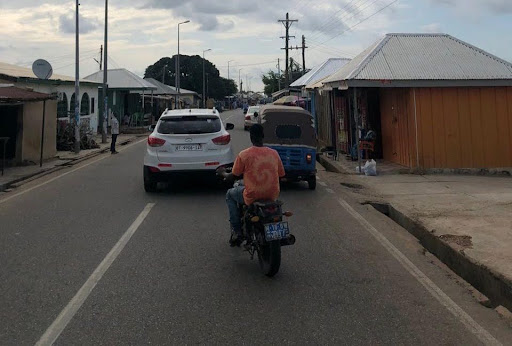 A section of the Insurance Road in Wa indicating how narrow it is, filled with shops and homes on either sides, leaving no room for cyclists and pedestrians.
Ghana’s transport sector produces close to half of the country’s energy-related emissions, according to the United Nations Environment Programme, and that share is projected to keep climbing as more vehicles crowd the roads. Cycling produces none of that. It is cheap, it requires no fuel, and Ghana’s own National Transport Policy already calls it “non-polluting and largely sustainable.” Yet the children and adults who actually cycle in Ghana do so on roads that were not designed with them in mind, sharing narrow lanes with cars, trucks, and motorcycles that treat them, at best, as an inconvenience.
Hundreds of kilometres away in Tamale, 12-year-old Husien Suglo rides to school every morning with a group of friends, because riding alone feels riskier than riding in a pack. However, riding in numbers also brings its own problems. Some of the students are pressed into the middle of the road while riding together.
His classmate Alhassan Mohammed Abideen has been cycling to school for six years, since he was in primary school, because it is the only practical way to cover the distance from his home to the school. He said he takes his time and stays alert but he has been frightened on the road more than once by big trucks and other speeding vehicles. Asked what would change things for him, he said a school bus because he could not fathom a way where cycling would be safe.
That is the answer of a child, not a policymaker, but it points at the same question this story keeps returning to: whether cycling can become a real piece of Ghana’s response to dirty air and rising emissions, rather than something people do despite the roads, a question the country has been answering only on paper for years.
Ghana first wrote much of that answer down in 2008 and revised it in 2020. The National Transport Policy recognizes walking, bicycles, pushcarts and animal-drawn carts as forms of “non-motorized transport,” describes NMT as non-polluting and sustainable, and commits the government to “integrate non-motorised transport facilities in all transport infrastructure developments.” It promises dedicated, safe, reliable facilities for the people who use them, and it singles out northern Ghana; the Northern, Upper East and Upper West regions, as an area where non-motorized transport is especially common. The policy also acknowledges, in plain language, why that matters: cyclists and pedestrians are vulnerable to fatalities, it says, partly because of inadequate safety measures and partly because drivers do not reliably recognize or respect them.
Cycling shows up again in Ghana’s climate commitments. The Ghana Carbon Registry, run by the Environmental Protection Agency, lists new bicycle lanes among the country’s transport-sector mitigation actions, and Ghana’s Third Biennial Update Report to the United Nations names bicycle-lane construction as one of 33 measures meant to cut transport emissions.
In 2021, the Ministry of Transport marked World Bicycle Day by promoting a bicycle-sharing initiative it said would help reduce air and noise pollution.
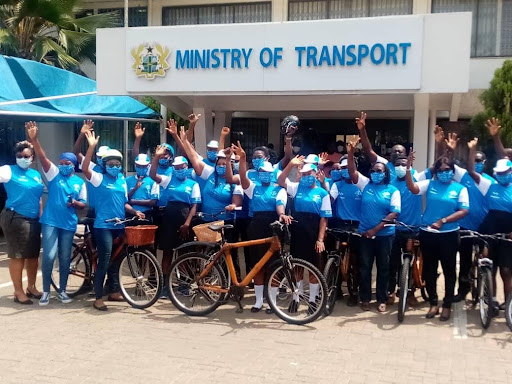
A National Cycling Policy, aimed at dedicated lanes in major cities, cycling education in schools and cycling tourism, has been in development for years without being finalized.
What exists on the ground looks different. Ing Peter Amoako, who until recently served as Upper East Regional Director for Urban Roads before being reassigned to the department’s national office, put it bluntly: “There are no official records of cycling lanes in Ghana.”
That is not the same as saying no cycling infrastructure exists anywhere in the country. Ing Amoako’s statement describes the absence of documentation, not a nationwide survey of every road. But for a department responsible for building and tracking road infrastructure, experts say the absence of any official record is itself a kind of answer.
John Quarshie, the Upper East Regional Public Affairs Officer for the National Road Safety Authority, framed the consequence in a recent radio interview on A1 Radio when discussing the spate of road accidents in the region: “Cyclists and pedestrians remain the most at risk on our roads because of the current road infrastructure.”
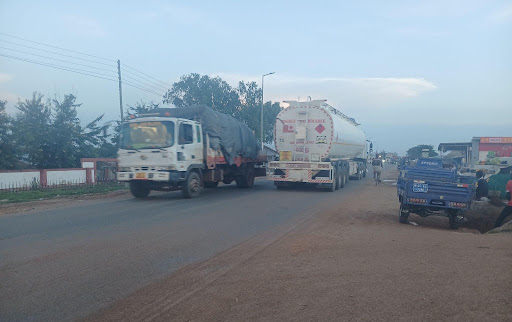
A cyclist pressed by a vehicle to the side of the road in Bolgatanga
James Kumbeni has spent the past five years testing that infrastructure at close range. A Bolgatanga-based IT professional and climate advocate, Kumbeni took up cycling for the adventure and the exercise, then watched his rides turn into something more public as people began following his trips online.
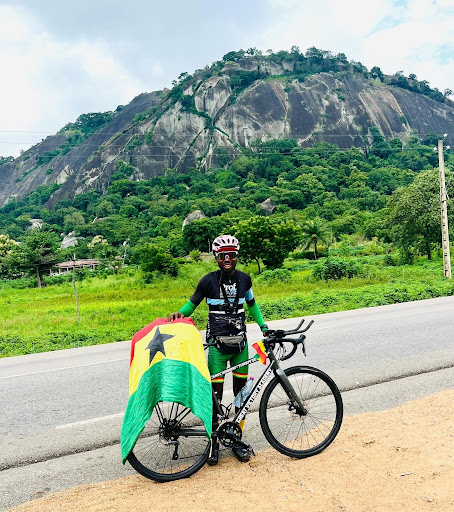
“The question was, how can my cycling impact society?” he said. “The closest impact of cycling was climate change.” In April 2024, he rode 815 kilometers from Bolgatanga to Accra in support of a friend competing for a Guiness World Record, Joel Atinga.
Kumbeni framed the ride as a statement about zero-emission travel. What it also gave him, over more than a week on the road, was a close survey of how Ghana treats cyclists. “The sad thing was that were no cycling lanes,” he said. “Even now, still no cycling lanes, which is a major safety concern for cyclists. Our Ghanaian roads are not built with cyclists in mind,” he said.
Kumbeni also tracks his own numbers. He rides with a cycling computer that logs distance, route and, by his account, the carbon emissions he avoids by choosing a bicycle over a car. By his own figures, self-reported, from his device, not independently verified, a roughly 1,500-kilometre round trip to Benin earlier this year saved 406 kilograms of carbon emissions; riding alongside a fellow cyclist. The two of them together avoided a combined 812 kilograms. Kumbeni said those numbers are evidence policymakers should see.
“If they see this practical data, I believe they will make better policies to favour cycling and emission reduction.” Whether his device’s calculations would hold up against a formal emissions audit is a separate question, but the number he carries with him, ride after ride, is the argument he is making with his body.
Kumbeni founded a cycling group in Bolgatanga, Keekee Cycling Konnect, partly to build a community and partly to press the safety argument publicly; the group has organized rides that included the Environmental Protection Agency and the Road Safety Authority. He said the response from people he has tried to recruit is consistent: fear of the road. He believes that this barrier would soften if there were somewhere safe to ride. “If we have cycling infrastructure, many in Bolgatanga would cycle as means of transport,” he said. “Many have said this to me.”
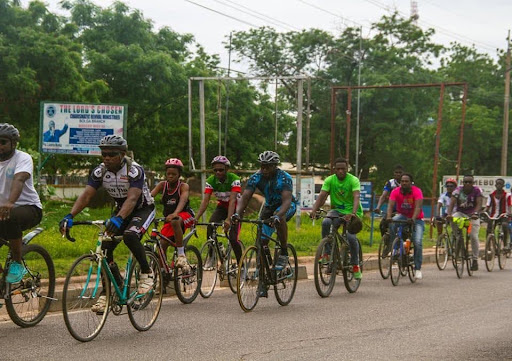
Keeke Cycling Konnect
It was Kumbeni, in fact, who gave a helmet to Mary Aduko, a 12-year-old student at St. John’s Catholic Junior High School near Bolgatanga who has been cycling to school for a year.
She rides, she said, because it is exercise, and it saves her parents money as well. To ensure she is safe of the road, she rides as slowly as she can, and on busy stretches, she stops and waits for traffic to pass rather than ride through it, which means her trip to school takes longer than it should. She has not had trouble with other road users, she said, but the road itself is the difficulty, too narrow, too fast, not built for a child.
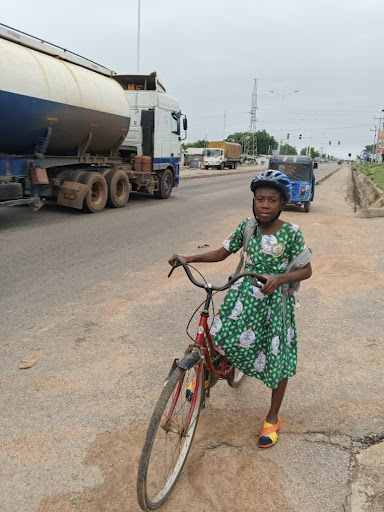
Mary Aduko riding by the roadside. What is supposed to be a cycling lane sometimes is taken over by tricycles as seen here
That distinction, a road’s design, rather than any single reckless driver, is what Dr Abdul Muizz-Muktar, a senior lecturer in environmental and occupational health at the University for Development Studies in Tamale, argued Ghana needs to take seriously as a public health matter, not only a transport one. Motorized transport is an important source of urban air pollution in Ghana, he said, though not the only one; household fuel burning, waste burning, industry, construction and road dust all contribute. What makes traffic pollution distinct, he said, is proximity: vehicle emissions are released exactly where people live, work, walk and cycle, so congestion concentrates exposure on the people least protected from it, pedestrians, cyclists, roadside traders, drivers themselves.
The pollutants he named as most concerning are fine particulate matter, PM2.5 and PM10, along with nitrogen dioxide, carbon monoxide, volatile organic compounds and black carbon. PM2.5 is small enough to penetrate deep into the lungs and enter the bloodstream, raising the risk of heart and respiratory disease; nitrogen dioxide is tied closely to combustion and traffic and can aggravate asthma.
Air pollution and climate change are not the same problem, Muizz-Muktar was careful to note. Air pollution hurts the people breathing it in, right now, in a specific place. Greenhouse gases work differently; they build up in the atmosphere over time and warm the whole planet, no matter where they came from. Switching from cars to bicycles can help with both, he said, but in different ways. Cleaner air on the streets where trips actually get replaced, and lower emissions overall if enough people make that switch.
He was just as careful about what cycling cannot do alone. “Simply telling people to cycle will not solve Ghana’s transport-related air pollution problem,” he said. The real gains only come when cycling is combined with better public transport, cleaner vehicles, better traffic management, and actual walking and cycling infrastructure.
He also pointed out something that complicates the simple case for cycling: riders breathe harder and more often than someone sitting in a car. On a busy, polluted road, that can mean a cyclist actually breathes in more pollution, not less. So the goal, he said, should be cleaner and safer environments for cycling, routes kept away from major traffic where possible, protected lanes that actually separate bikes from cars, and air-quality monitoring that shows where the exposure is worst.
That increased exposure has consequences inside the body. Dr Emmanuel Anafo, a physician specialist at the Upper East Regional Hospital, said exhaust and fine particulate matter can irritate the airways almost immediately, causing coughing and inflammation as some of the smallest particles travel deep into the lungs.
“Inhaling exhaust and fine particulate matter triggers immediate airway irritation, coughing, and swelling as tiny particles bypass natural nasal filters to lodge deep within the lungs’ alveoli,” Anafo said.
Repeated exposure can be more damaging. Over time, the continuing inflammation and oxidative stress can damage lung tissue, narrow the airways and reduce lung function, increasing the risk of respiratory diseases.
For people already cycling on Ghana’s congested roads, Anafo said there are ways to reduce the amount of pollution they breathe. Where possible, cyclists can use quieter parallel streets, avoid riding directly behind buses, trucks and other large vehicles, move away from lines of idling vehicles at traffic lights and avoid peak traffic periods.
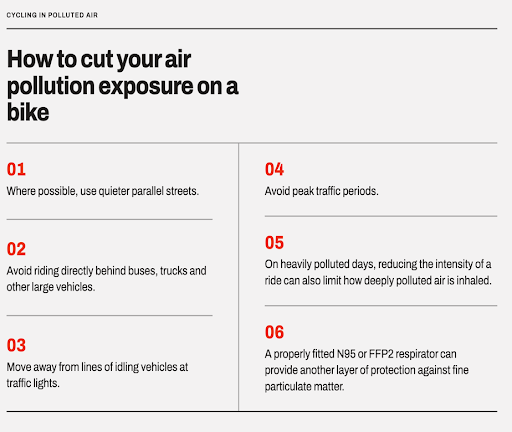
On heavily polluted days, reducing the intensity of a ride can also limit how deeply polluted air is inhaled. A properly fitted N95 or FFP2 respirator, he said, can provide another layer of protection against fine particulate matter.
But his advice also exposes the limits of what individual cyclists can do.. None of those precautions separates a bicycle from motorised traffic where both have been given the same road space.
Multiple African cities have tried to build exactly that kind of separation, with mixed and instructive results. Kigali has run car-free Sundays since 2016, a low-cost, repeatable intervention that built cycling culture before infrastructure caught up; the city has since added roughly 13 kilometres of bike lanes in its central business district, backed by a national transport policy that embeds non-motorized transport directly into its planning, developed with support from the same UNEP-backed technical assistance program that has advised Ghana.
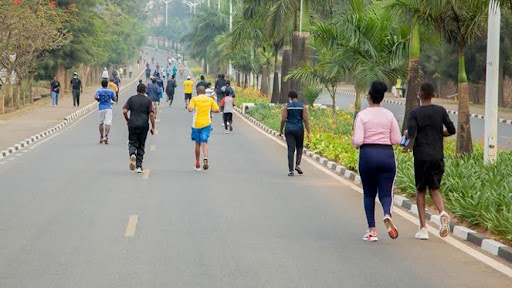
Kigali Car Free Sunday – Source: Kigali City
Nairobi has gone further on paper, requiring that all new roads include a footpath and a bike path and setting aside a percentage of the city’s transport budget for active mobility; a binding mandate, not an aspiration. Addis Ababa has set a target of 200 kilometres of new bike lanes by the end of 2028, tied to a broader push to rebuild transport corridors. Kisumu, in Kenya, has taken a narrower but concrete approach, building roughly 8 kilometres of cycling infrastructure with World Bank funding. Cairo chose a different model entirely, launching a solar-powered bike-share scheme that started with 255 bicycles across 25 stations.
None of these examples translate directly onto Ghanaian roads. Kigali’s progress rests on sustained political commitment and years of car-free programming that shaped behavior before infrastructure arrived; Nairobi’s rests on a legal requirement that Ghana’s own transport policy does not currently contain. What the comparison does make clear is the difference between Ghana’s approach and theirs: in Kigali and Nairobi, stated policy was paired with either a binding construction requirement or a sustained, funded program to change habits. In Ghana, according to the reporting gathered for this story, the policy language has largely stood alone. Parliament approved roughly Ghc 5.3 billion for the 2026 fiscal year. Whether any of that funding is earmarked specifically for cycling infrastructure is not established in any report seen by this reporter.
Husien Suglo will ride to school again tomorrow, the way he does every morning, with his friends around him because riding alone feels worse than riding in a crowd. When the road narrows and the traffic presses in, some of the boys will drift toward the middle of the lane, because there is nowhere else to go. Drivers will continue to shout at them but nobody has given them anywhere else to ride.
Ghana’s own transport policy has a name for what Husien is doing. It calls it non-motorized transport, and it calls it the future. It has not yet called it safe.
This story was a collaboration with New Narratives. Funding was provided by the Clean Air Fund. The donor had no say in the story’s content.