
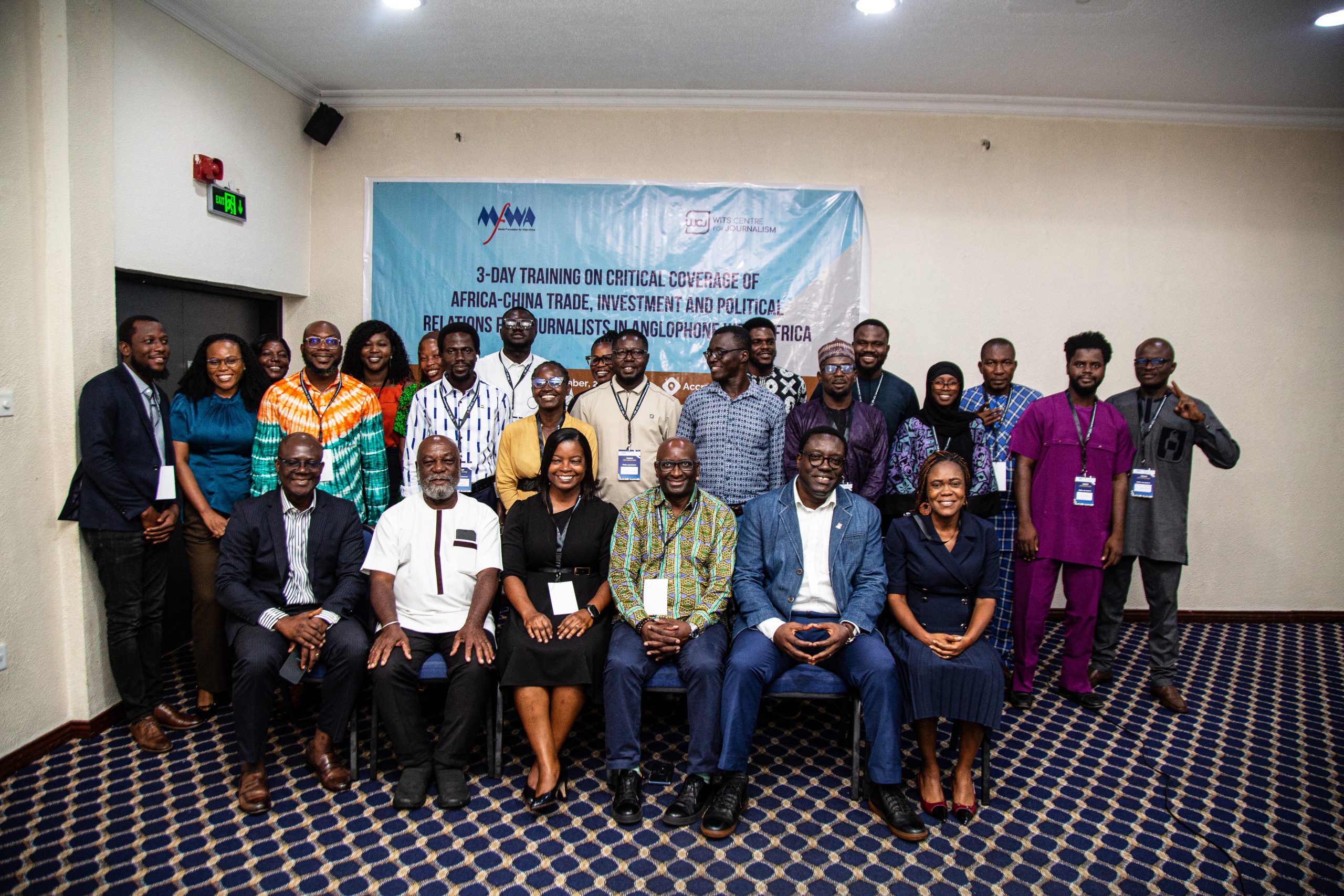
Experts in economics, media, security, technology and natural resources have called for a more rigorous and evidence-based approach to understanding and reporting Africa-China relations, warning against simplistic narratives that portray China either as an unquestionable development partner or an exploiter of the continent.
They made the call during a three-day training on critical coverage of Africa-China trade, investment and political relations for journalists in Anglophone West Africa in Accra, Ghana.
The training was organised by the Media Foundation for West Africa (MFWA) in partnership with the Wits Centre for Journalism (WCJ) in South Africa to strengthen understanding of Africa-China relations within an increasingly multipolar global environment and their implications for African development and communities.
Out of 606 applications received, 22 journalists from Ghana, Nigeria, The Gambia, Sierra Leone and Liberia were selected to participate.
Opening the training, Professor Kwame Karikari, Board Member of the MFWA, said China’s growing influence in Africa must be understood within the broader history of global competition for the continent’s resources and markets.
He said China had evolved from supporting African liberation movements to becoming a major economic and political power whose interests in Africa must be critically examined alongside those of other global powers.
According to Professor Karikari, Africa is experiencing what many analysts describe as a new scramble for the continent, with China and other economic powers competing for access to natural resources while seeking markets for their products.
He urged African media organisations to place the interests of African countries and citizens at the centre of their coverage.
“The media has the responsibility to seek, to clarify, educate and advocate for what the interests of our people are and how to promote our interests in these highly complex relations.”
Professor Karikari cautioned against allowing coverage of China’s activities to become an extension of either Chinese or Western propaganda.
“Our media must stay independent, focus on our people’s interests and must not become instruments of China’s propaganda for its own interests.”
He also warned against exaggerated anti-China narratives, saying negative developments involving Chinese entities should be investigated, but should not be used to promote xenophobia.
“We must not at all cover up negative outcomes or wrongdoings by Chinese entities in our relations with China. But our media must not become outlets for broadcasting exaggerated negative stories about relations with China.”
Africa-China relations differ across countries
Chris Kabwato of the Wits Centre for Journalism said Africa’s relationship with China could not be treated as a single continental experience because the 54 African countries have different economic structures, resources and political circumstances.
He said the Africa-China Reporting Project, which has been running for a decade, was established against the backdrop of China’s growing role as a major development partner on the continent.
Mr. Kabwato argued that journalists need a deeper understanding of China’s history, political system and economic transformation to properly assess its engagement with African countries.
He cited the experience of countries where Chinese companies have significant control of mining assets as an indication of why country-specific reporting was necessary.
“We need to build a deeper understanding in order for us as journalists to serve our audiences with critical information and useful insights.”
He said understanding China’s transformation from an economically underdeveloped country into a global power was essential to explaining its current policies and interests in Africa.
Media framing shapes perceptions
The issue of how Africa-China relations are presented to the public was further examined by Professor Abena Yeboah-Banin, Dean of the School of Information and Communication Studies at the University of Ghana.
Speaking on media framing, balance and evidence-led reporting, she said the choice of words, images and context could influence how audiences perceive China and its activities on the continent.
She identified three broad approaches in the literature: Western media portrayals of China’s activities in Africa, Chinese and pro-China narratives, and African media coverage.
According to her, Western coverage can sometimes portray China as a powerful actor seeking to exploit African resources, while Chinese media often emphasise South-South cooperation, infrastructure development and mutual benefits.
African media, she noted, can reproduce either negative or overly positive narratives without sufficiently interrogating the underlying interests and power relationships.
Professor Yeboah-Banin said journalists must therefore examine their own assumptions and the implications of the language and imagery they use.
“Whenever you are writing a sentence, a word, a paragraph, a story, to step back and look at it again and say, am I really saying what I intend to say?”
She urged journalists to move beyond binary portrayals and interrogate the evidence behind competing claims.
Africa must address structural weaknesses in its trade with China
Dr. Nii Moi Thompson, Economist and Chairman of the National Development Planning Commission, focused on the economic structure of Africa-China trade, particularly the imbalance between African commodity exports and manufactured imports.
He said the pattern reflected deeper weaknesses within African economies rather than China alone, including low productivity, inadequate infrastructure, limited industrial capacity and insufficient electricity supply.
Data presented during the session showed that minerals, ores and metals accounted for a growing share of African exports to China, rising from 23 percent in 2000 to 35 percent in 2024.
Over the same period, machinery accounted for an increasing share of imports from China, rising from 38 percent to 52 percent.
Dr. Thompson said the challenge was not simply that China was buying African minerals, but that African countries had failed to develop sufficient capacity to transform their natural resources into higher-value products.
“Ultimately, the responsibility lies with them. The idea is not to excuse anyone. But we are in charge.”
He said Africa’s weak industrial base, low electricity consumption and poor productivity continued to limit its ability to compete in global markets.
He also warned that the growing presence of cheap or subsidised imports could undermine local manufacturing, employment and government revenue if not properly managed.
“Your manufacturer’s share of merchandise exports is a critical measure of your own economic resilience.”
Dr. Thompson argued that African countries needed long-term development strategies that transcend political cycles and strengthen industrialisation, infrastructure, energy supply and productivity.
China’s security role requires greater scrutiny
Security analyst Colonel Festus B. Aboagye (Rtd) said China’s engagement with Africa had moved beyond trade and infrastructure into an increasingly significant security relationship.
He noted that China’s involvement included military training, arms transfers, police cooperation, peacekeeping, maritime security, intelligence sharing and defence-related education.
He said the security dimension had grown particularly strongly from around 2015, although China’s involvement in Africa’s security affairs had historical roots dating back to the liberation struggles.
Colonel Aboagye cautioned against viewing China’s security engagement in isolation from the activities of other foreign powers.
“China did not introduce us to foreign military partnerships. Before China came, all of us within the country were already engaging with other partners.”
He said the appropriate question was not simply whether China’s involvement was good or bad for Africa, but whether African countries had the institutions and oversight mechanisms necessary to protect their national interests.
“The better question is, do African countries have institutions, the transparency, the oversight, and strategy to make this relationship serve African interests?”
He also criticised African governments for failing to provide sufficient transparency around some defence agreements and procurement arrangements involving China and other external partners.
Chinese presence in mining presents both opportunities and risks
Daryl Bosu, Deputy National Director of Operations at A Rocha Ghana, examined China’s growing role in the mining sector across Anglophone West Africa.
He said Chinese interests span gold, lithium, iron ore, manganese and bauxite, with Ghana, Nigeria, Sierra Leone and Liberia experiencing varying levels of Chinese investment.
The presentation noted China’s dominant position in the global processing of several critical minerals and the strategic importance of securing supplies of resources needed for industrial production and the energy transition.
In Ghana, Chinese interests include gold, lithium, bauxite and manganese, while Chinese-linked investments are also prominent in infrastructure associated with mineral production and transportation.
Mr Bosu, however, stressed that the impact of Chinese mining investments was mixed. Chinese-linked projects can generate jobs, infrastructure, financing and technology transfer, but mining can also result in land degradation, livelihood disruption, pollution, health concerns and governance problems.
He said weak institutions, corruption and poor enforcement were often more important determinants of negative outcomes than the nationality of investors.
The presentation therefore urged governments to strengthen regulation, enforce local-content requirements, improve beneficial-ownership transparency and ensure meaningful community participation.
For journalists, he recommended following individual mining projects from licensing through production rather than relying on broad narratives about Chinese investment.
He also urged reporters to examine ownership structures, mining agreements, environmental assessments, community benefits and regulatory enforcement using primary documents and independently verifiable data.
Technology raises new questions about surveillance and influence
Eliud Akwei, Senior Investigative Data Analyst and Certified Fraud Examiner at Code for Africa, highlighted the growing role of technology in Africa-China relations, including surveillance, information influence and open-source intelligence.
He drew attention to the growing use of Chinese-sourced surveillance technology across African countries and questions surrounding data ownership, storage and national security.
He cited Nigeria’s investment in CCTV infrastructure as an example of the need to examine who controls surveillance systems and where the data generated by such systems is stored.
Mr Akwei also demonstrated how digital investigation tools can help journalists identify narratives and track how particular issues are being discussed across African media platforms.
He encouraged journalists to identify a narrative, develop relevant keywords and use structured searches to examine how different media organisations are reporting the issue.
He explained that tools using Boolean searches could help reporters locate patterns in media coverage by combining terms using operators such as “and,” “or” and “not.”
He also warned journalists about digital security risks, including compromised passwords, surveillance tools and social engineering, and urged them to adopt stronger password practices and other security measures.
Evidence must remain at the centre of reporting
Across the sessions, speakers stressed that Africa-China relations should not be reduced to a contest between competing geopolitical narratives.
The experts urged journalists to examine the specific interests of African governments, Chinese companies, local communities and other external powers involved in particular transactions or projects.
They also called for greater attention to primary documents, company records, government agreements, parliamentary records, court decisions, environmental data and direct community testimony.
The training emphasised that the growing Chinese presence in Africa creates both opportunities and risks, but that the ultimate outcome depends significantly on the capacity of African institutions to negotiate, regulate and enforce agreements in the public interest.
The discussions consequently placed responsibility on African governments and institutions to improve transparency, strengthen governance and develop the industrial and economic capacity required to derive greater value from relations with China.
For the media, the central challenge is to provide citizens with accurate, independent and nuanced information that allows them to understand not only what China is doing in Africa, but also why it is doing so, who benefits, who bears the costs and what African governments are doing to protect their countries’ long-term interests.
A1 Radio|101.1 MHz|Joshua Asaah