Home Blog Page 11

BTU’s smart flood monitoring system wins 2026 Women in Engineering competition

0

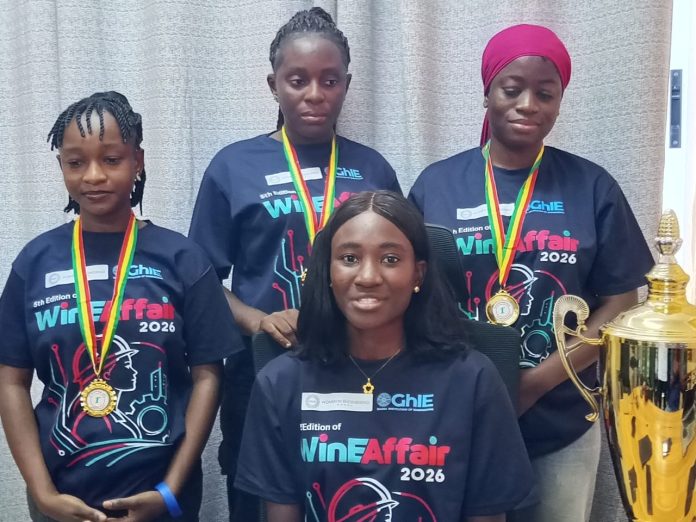
Bolgatanga Technical University (BTU) has emerged winner of the 2026 Women in Engineering (WiNE) Affair competition after developing a smart emergency communication system designed to detect floods and help emergency responders locate people in danger.

The university beat 18 other participating tertiary institutions, including Kwame Nkrumah University of Science and Technology (KNUST), University for Development Studies (UDS) and the University of Ghana, to claim the top prize.

The competition, organised under the Ghana Institution of Engineering (GhIE), was held at Ho Technical University and brought together female engineering students to develop innovative solutions to challenges affecting communities.
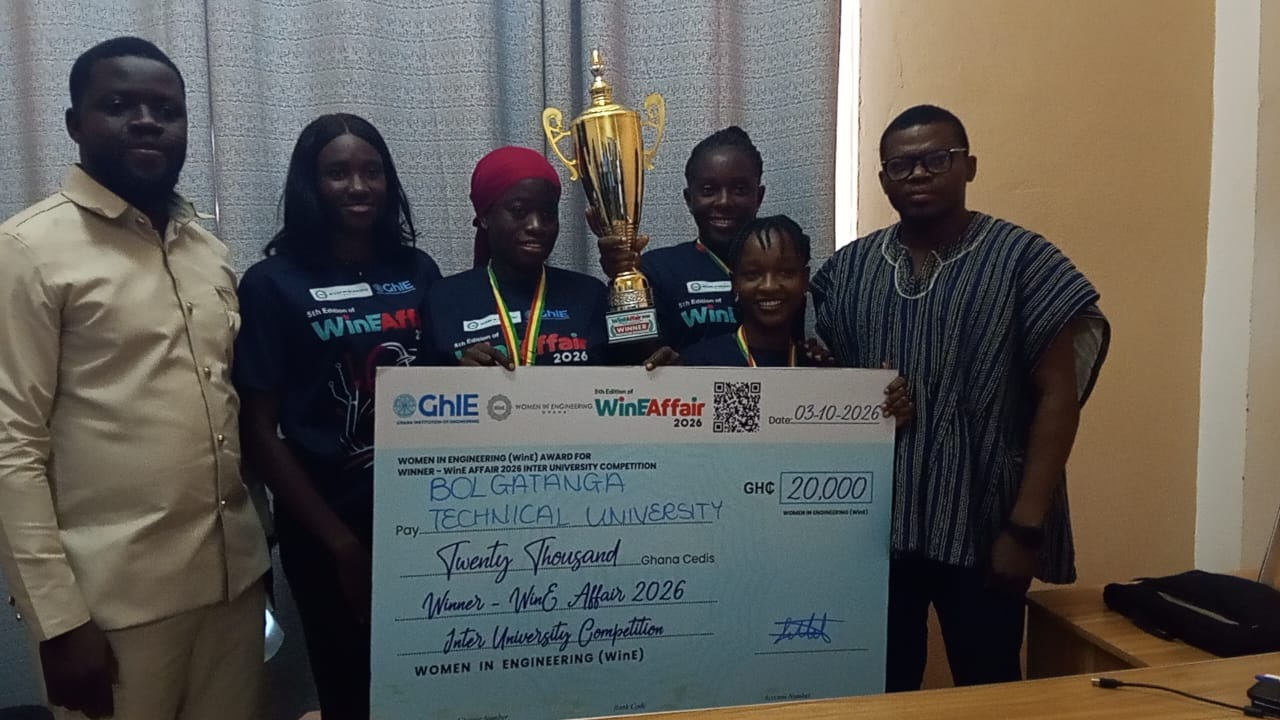
BTU received a trophy and a cash prize of GH¢20,000 for its winning project, Smart Emergency Communication System with Flood Monitoring.

The innovation is designed to automatically detect flooding and send emergency alerts, including GPS location information, to assist agencies such as the National Disaster Management Organisation (NADMO) and the Ghana National Fire Service in responding to emergencies.

Speaking at BTU after the team’s return from the competition, Aurelia Ayamdor, a lecturer in the Department of Electrical and Electronics Engineering who led the team, explained that participating institutions were tasked with developing solutions to real problems affecting communities.

“For the Wine Affair 2026, projects were given to the various universities to come out with a solution for a problem to be solved in the community. And we know that recently there was flooding in various regions. So our team came out with a solution, which is a smart emergency communication with a flood monitoring system,” she said.

According to her, the system was developed in response to recurring floods in Ghana, which have caused deaths, displaced residents and damaged properties in several communities.

She explained that the device could help emergency responders identify the locations of people trapped during flooding.

“This device can help save lives of people, those who are trapped during flooding. So it’s a communication system that communicates to respondents, for example the fire service, NADMO, in order to come to save the lives of the people. This system has a GPS location where they are able to locate the victims to save their lives,” she said.

Madam Ayamdor attributed the team’s success to its determination and preparation ahead of the competition.

She urged university management to invest more in practical engineering activities, particularly initiatives that encourage women to develop technical skills and pursue careers in engineering.

“Management should invest more in these kind of activities so that they are able to develop more of their skills, especially women in engineering, because ladies in engineering is something that is difficult. It’s not easy,” she added.

The Dean of BTU’s School of Engineering, Eng. Dr George Alexander Dordah, said the achievement demonstrated the ability of students to apply classroom knowledge to practical challenges confronting society.

“This competition was all about innovation, how to innovate to solve problems in our society. What this means for us goes beyond just winning. It demonstrates that our students can apply the knowledge we are giving them here to develop, innovate, and solve problems in society,” he said.

Dr Dordah said the project was particularly relevant given the recurring flooding experienced in parts of Ghana, including communities in Northern Ghana affected by the spillage of the Bagre Dam and flood-prone areas in Accra.

He explained that the system was designed to detect flooding and transmit alerts without requiring someone to manually activate it.

“It is important that we are able to early detect these floods. With this device, it’s very easy. The good thing about it is that you don’t need somebody triggering it. Once it senses the flood, it goes ahead to send signals and indicate where you can actually locate whoever is in a problem. And so it becomes easy to save people,” he said.

He said the university would continue to emphasise practical training that enables students to develop solutions to challenges facing communities and industry.

The Students’ Representative Council (SRC) President, Kenneth Atonka Nsoyine, also congratulated the team, describing the achievement as a reflection of the students’ dedication and teamwork.

“Your achievement is a true reflection of the hard work, dedication, discipline and determination of the students of Bolga Technical University. You have represented BTU with pride and excellence, proving that when talent is supported by dedication and teamwork, great things are possible,” he said.

A1 Radio | 101.1 MHz | David Azure | Bolgatanga

Kacstone Records MD calls for more private investment in Upper East tourism

0
The Managing Director of Kacstone Records, Wenawome Duriyem Aborah, has urged business owners and individuals with financial resources in the Upper East Region to invest in culture, entertainment and tourism to create employment opportunities for young people.

He said the region’s cultural heritage and tourism potential could support a range of businesses if investors were willing to look beyond immediate financial returns and invest in infrastructure, skills development and the promotion of local attractions.

Speaking on A1 Radio’s programme, Turning Culture into Employment: Adapting the Local Way, Mr Aborah said Northern Ghana’s diverse cultural traditions were not receiving adequate exposure because of limited investment, inadequate infrastructure and poor presentation.

“It is about time we ourselves package ourselves and throw it to the world,” he said.

Mr Aborah, who is also Chairman of the Paga Youth Movement, said he had invested in LED screens, sound systems and other event equipment to help improve the quality of events organised in the Upper East Region.

According to him, the investment was partly intended to reduce the need for event organisers to bring equipment and technical services from Accra and other parts of the country.

He argued that the difference between events organised in Northern Ghana and those held in cities such as Accra and Kumasi was often not the quality of the cultural content but the equipment, branding and presentation.

Mr Aborah said he had also trained young people in Paga to operate and manage the equipment, providing them with skills and opportunities to earn income through the events industry.

He acknowledged that investments in culture and entertainment might not always produce immediate financial returns but said their potential to create employment and develop the region should encourage more people to participate.

“I encourage many more people to invest into it,” he said.

He urged individuals with resources to consider how their investments could benefit communities and create opportunities for young people beyond their immediate families.

“Don’t just look at the immediate benefit that you want to benefit with your family. But create avenues for other youth to emulate from you,” he stated.

Mr Aborah also called for stronger collaboration among communities in the Upper East Region to promote their cultural identities and traditions.

He said cultural differences should be used to encourage tourism and strengthen relationships among communities rather than become sources of division.

According to him, organising events that bring together different cultural groups could help residents appreciate one another’s traditions while creating opportunities for traders, entertainers and other businesses.

He also stressed the importance of preserving local languages and traditions as part of efforts to develop a distinctive tourism identity for the region.

Mr Aborah cited the Volta Region as an example of an area he believes has made deliberate efforts to promote its tourism identity, urging stakeholders in the Upper East Region to adopt a similarly coordinated approach.

He further proposed developing tourism activities around the region’s landscapes and seasonal characteristics, including events during the rainy and dry seasons.

Such initiatives, he argued, could attract visitors at different times of the year and provide additional business opportunities for local communities.

Mr Aborah maintained that the region’s culture and tourism attractions should be treated as economic assets capable of generating income and employment rather than resources preserved solely for occasional celebrations.

A1 Radio | 101.1 MHz | Moses Apiah | Bolgatanga

Upper East losing tourism opportunities over neglected heritage sites – Aborah

0

The Managing Director of Kacstone Records, Wenawome Duriyem Aborah, has raised concerns about the neglect of historical and cultural sites in the Upper East Region, warning that the situation is depriving communities of potential tourism revenue and employment opportunities.

He cited Karimenga Hill, which he said has a safe house reportedly used by Ghana’s first President, Dr Kwame Nkrumah, as one of the historical attractions that could be developed to attract visitors but has been allowed to deteriorate.

Mr Aborah, who is also Chairman of the Paga Youth Movement, said the site could be restored and equipped with facilities to help visitors appreciate its historical significance while creating business opportunities for surrounding communities.

According to him, several other locations across the Upper East Region have historical and cultural significance but remain largely undeveloped because of inadequate investment and the absence of deliberate plans to promote them as tourism destinations.

He argued that preserving such sites should go beyond protecting their historical value to creating economic opportunities for residents, particularly young people.

“Tourism should be an employable entity,” he said.

Mr Aborah made the observations following his participation in a tourism industry engagement in Lesotho, where he said he witnessed efforts to develop heritage sites into organised attractions that generate revenue.

He explained that some tourism destinations in Lesotho were supported by facilities for entertainment, conferences and other activities that encouraged visitors to spend money within the local economy.

He believes the Upper East Region could adopt similar approaches by identifying historical landmarks, preserving their significance and developing complementary services around them.

Mr Aborah also raised concerns about the management of some heritage sites, arguing that treating culturally significant locations solely as private family properties could limit opportunities for their development.

He called for appropriate arrangements involving traditional authorities, communities, government agencies and private investors to ensure that such sites are preserved and developed for public benefit.

Beyond Karimenga Hill, Mr Aborah mentioned the historic mosque at Pusiga as another attraction he believes has not received sufficient attention to realise its tourism potential.

He said the region’s historical landmarks, cultural traditions and community histories could attract both domestic and international visitors if properly documented, preserved and promoted.

Mr Aborah therefore urged stakeholders to develop a coordinated approach to tourism that would protect the region’s heritage while creating sustainable livelihoods for communities.

A1 Radio | 101.1 MHz | Moses Apiah | Bolgatanga

Stop treating festivals as mere celebrations, turn culture into jobs – Aborah

0

The Managing Director of Kacstone Records, Wenawome Duriyem Aborah, has called for deliberate investment in tourism and cultural activities in the Upper East Region to create sustainable employment opportunities, particularly for young people.

He said the region’s tourism attractions, festivals and cultural heritage could support businesses in hospitality, transportation, food services, entertainment and handicrafts if developed into a structured industry.

Mr Aborah, who is also Chairman of the Paga Youth Movement, argued that tourism should be treated as an economic opportunity rather than an activity centred mainly on festivals and occasional visits to tourist attractions.

“Tourism is a basket of employment that gives a value chain,” he said.

According to him, the economic benefits of tourism extend beyond the operators of tourist attractions to businesses and individuals providing services to visitors.

He said developing the sector could create opportunities for young people who are struggling to secure formal employment, particularly in communities with established tourism attractions.

Mr Aborah made the remarks following his participation in a tourism industry engagement in Lesotho, where he observed efforts to position tourism as a source of employment and economic growth.

He said the experience demonstrated the importance of deliberately developing the skills of people living around tourist destinations and supporting them to take advantage of business opportunities.

Mr Aborah believes Ghana, particularly the Upper East Region, could adopt similar approaches by providing training and other forms of support to people interested in operating tourism-related businesses.

He said such interventions should not be restricted to students or people in formal education but should also target unemployed young people and residents of communities surrounding tourist attractions.

According to him, training people in hospitality, customer service, entertainment, handicrafts and other tourism-related activities could help communities derive greater economic benefits from their cultural and natural resources.

He also called for stronger collaboration among government agencies, traditional authorities, private investors and local communities to develop the sector.

Mr Aborah argued that government alone could not provide employment for everyone and that private investment and community participation would be essential to expanding opportunities in tourism.

He urged stakeholders to develop activities and events around the Upper East Region’s distinctive landscapes, cultural traditions and seasonal attractions to encourage more visits and create business opportunities.

He maintained that tourism destinations should be developed into economic assets that support livelihoods throughout the year rather than places visitors merely tour before leaving.

A1 Radio | 101.1 MHz | Moses Apiah | Bolgatanga

Invest in journalists, stop treating media scrutiny as attacks – Dr Apaak

0

Deputy Minister for Education Dr Clement Abas Apaak has called on media organisations to invest in journalists and urged public institutions to stop treating legitimate questions from reporters as attacks.

He said producing credible investigative and development journalism requires adequate resources, access to information and strong editorial oversight, while public institutions must be prepared to account for their decisions and use of public resources.

Speaking at the 5th Upper East Regional Ghana Journalists Association (GJA) Awards in Bolgatanga, Dr Apaak said journalists could not be expected to produce quality accountability stories without the necessary support from their newsrooms.

“If we want stronger investigative and development journalism out of the Upper East Region, we must invest in the journalists who are expected to produce it,” he said.

According to him, journalists need sufficient time, transport and access to information to investigate issues thoroughly, while editors must be prepared to question the evidence supporting their reports.

He said editors should routinely challenge reporters to establish the sources of figures, seek responses from people or institutions mentioned in their stories and verify claims before publication.

Dr Apaak argued that such editorial scrutiny was necessary to protect the credibility of journalism and strengthen public confidence in media reporting.

He also urged public institutions to respond constructively when journalists raise questions about public services, development projects and the management of public resources.

“A journalist’s question is not automatically an attack,” he stated.

The Deputy Minister said questions about why a health facility lacks water or why a development project has stalled should be treated as legitimate accountability concerns rather than attempts to discredit the institutions responsible.

“Where the media gets something wrong, correct the record. But where the question is fair, answer it. That is how accountability works,” he said.

Dr Apaak maintained that public institutions exist to serve citizens and therefore have a responsibility to provide credible answers when questions are raised about their performance.

He also reminded journalists that their responsibility to hold institutions accountable must be matched by a commitment to accuracy, fairness and verification.

According to him, reporters must give individuals and institutions opportunities to respond to allegations and correct mistakes when they occur.

The Deputy Minister further urged journalists in the Upper East Region to pursue sustained reporting on issues affecting communities, particularly in health, education, agriculture, water and sanitation.

He said journalists should not abandon stories after reporting initial developments but should continue examining whether promises have been fulfilled and public resources have produced the intended results.

“Do not leave the story at the headline. Stay with the issue. Follow the promise, follow the money, follow the people affected,” he said.

Dr Apaak was the Special Guest of Honour at the 5th Upper East Regional GJA Awards, which recognised journalists for their contributions to public-interest reporting and development in the region.

A1 Radio | 101.1 MHz | Moses Apiah | Bolgatanga

Education Ministry warns schools against unauthorised fees, diversion of students’ food

0

The Ministry of Education has warned school authorities across Ghana to stop charging unauthorised fees and diverting food intended for students, describing the reported practices as a breach of public trust.

Deputy Minister for Education Dr Clement Apaak said the Ministry had received troubling reports of some school managements imposing unapproved charges on parents and diverting food supplies meant for students.

Speaking at the 50th anniversary celebration of Zamse Senior High/Technical School (ZAMSTECH) in Bolgatanga, Dr Apaak said such practices were unacceptable and must stop.

“No parent should be asked to pay what was never sanctioned. No child should go hungry because food bought for their plate ended up somewhere else,” he said.

The Deputy Minister warned that school managements found engaging in such practices should not expect the Ministry to overlook them.

“Where this is happening, it must stop, and school managements across this country should hear this as a clear warning, not a suggestion,” he stated.

Dr Apaak, however, clarified that his comments were not directed at ZAMSTECH, its Board or Management, but reflected broader concerns about reports reaching the Ministry from schools across the country.

He said parents should not be compelled to pay fees that had not been approved by the appropriate authorities, while food and other resources provided for students must be used for their intended purposes.

According to him, accountability in education should extend beyond academic performance and infrastructure development to include the management of funds, food supplies and other resources entrusted to school authorities.

He stressed that resources provided by the government and parents were intended to support students’ education and welfare and should not be misappropriated.

The Deputy Minister also called on school authorities, parents, traditional leaders, alumni and other stakeholders to play their respective roles in ensuring that schools provide quality education in a safe and supportive environment.

Dr Apaak delivered the warning during ZAMSTECH’s Golden Jubilee celebration, held under the theme, “Empowering Minds and Shaping the Future: The Role of Stakeholders.”

A1 Radio | 101.1 MHz | Moses Apiah | Bolgatanga

Government working to address ZAMSTECH’s outstanding projects, vehicle needs – Apaak

0

The Ministry of Education says it is working with the Architectural and Engineering Services Limited (AESL) to address outstanding infrastructure needs at Zamse Senior High/Technical School (ZAMSTECH) in the Upper East Region.

Deputy Minister for Education Dr Clement Apaak said the Ministry was considering cost estimates submitted by AESL for projects identified by the school, alongside concerns about the need for a pick-up vehicle.

Speaking on behalf of the Minister for Education at ZAMSTECH’s 50th anniversary celebration, Dr Apaak assured the school’s management that the outstanding needs had received the Ministry’s attention.

“I want to assure the Board, Management and the entire ZAMSTECH community that these matters have the Minister’s attention, and that the Ministry is working with the Architectural and Engineering Services Limited on the cost estimates already submitted, with a view to progressing them as resources allow,” he said.

Although he did not provide a timeline for the implementation of the projects, Dr Apaak said government expected its commitment to the school to be assessed by the actions it takes following the anniversary celebration.

“Government’s commitment to this institution is not a matter of words alone, and we intend to be judged by what follows this visit,” he stated.

The Deputy Minister also linked the government’s commitment to ZAMSTECH to broader efforts to strengthen technical and vocational education in Ghana.

He said the country’s growing demand for technical skills in agriculture, construction, mechanics and other sectors required greater investment in institutions offering practical and vocational training.

According to him, schools such as ZAMSTECH have an important role to play in equipping young people with skills relevant to Ghana’s development needs.

Dr Apaak said the institution’s 50-year history demonstrated its contribution to secondary and technical education in the Upper East Region and its potential to support the country’s future workforce.

Established in 1976, ZAMSTECH is celebrating its Golden Jubilee under the theme, “Empowering Minds and Shaping the Future: The Role of Stakeholders.”

A1 Radio | 101.1 MHz | Moses Apiah | Bolgatanga

Teachers’ strike: Upper East students fear falling behind as classrooms remain without lessons

0

Students at Sacred Heart Junior High School in Bolgatanga say they have been reporting to school only to play and return home as the nationwide strike by pre-tertiary teacher unions continues to disrupt teaching and learning in the Upper East Region.

The students say the industrial action has deprived them of valuable instructional time, raising concerns about their preparation for examinations, particularly among final-year students.

“We only come to school to play and go back. Teaching and learning is not going on,” Muniu Ajira, a student of Sacred Heart Junior High School, told Bolga FM.

Another student, Sylvia Ayindosiya, said effective teaching had taken place for only about a week before the teachers embarked on the strike.

She expressed concern that students in the public section of the school were losing valuable instructional time while their colleagues in the private section of the same Catholic institution continued attending classes.

According to her, the disruption could affect their preparation for the Basic Education Certificate Examination (BECE).

She appealed to the government to urgently address the concerns of the striking teachers to allow academic activities to resume.

Schools across the Bolgatanga Municipality have been affected by the industrial action, with students and parents expressing growing concern about its impact on academic work.

The striking teacher unions have rejected appeals to call off the industrial action, insisting that outstanding concerns, including promotion-related salary arrears and deprived-area allowances, must be addressed.

A parent, Eric Nyaaba, said the prolonged disruption was particularly worrying for final-year Junior High School students preparing for the BECE.

“We don’t have much to say other than to appeal to the government to, as a matter of urgency, address the pressing challenges of the teachers for our children to get back to school and continue learning,” he said.

Mr Nyaaba also expressed concern about differences in access to education between public and private schools during the strike.

He alleged that some public school teachers enrol their own children in private schools while pupils in public schools continue to experience disruptions to learning.

Other students interviewed by Bolga FM also appealed to the government to resolve the dispute, warning that continued disruption could affect their academic performance.

“Please, we are begging the government to help us pay our teachers. Teaching and learning have not been stable for some time now. We have been having talks all the time, but we are still here, and no teaching and learning is going on,” one student said.

“This can seriously affect our academics because we are not learning and examinations are approaching. We are the future generation. We want to learn, make Ghana proud and contribute to the development of the country.”

A Senior High School student also expressed concern about the effect of the strike on final-year students.

“I am from the Upper East Region and I attend Senior High School. Because the teachers have gone on strike, it is affecting us, especially those of us in Form Three who will soon be writing our examinations,” the student said.

“Our teaching and learning is not going on well. It is affecting us because we are not learning. We are therefore calling on the government to pay the teachers so that they can come back to school and teaching and learning can resume.”

The students appealed to the government and teacher unions to reach an agreement that would allow teachers to return to the classroom and restore academic activities.

A1 Radio | 101.1 MHz | Moses Anaba Azubire | Bolgatanga

Teachers’ strike risks widening educational inequalities in Northern Ghana – NNED

0

The Northern Network for Education Development (NNED) has warned that the ongoing nationwide strike by pre-tertiary teacher unions could widen educational inequalities, particularly among children in rural and deprived communities in Northern Ghana.

The Network says prolonged disruptions to teaching and learning could place children in underserved communities at a greater disadvantage because many have limited access to alternative learning opportunities.

In a statement on the industrial action, NNED called on government and teacher unions to urgently resolve the impasse while protecting both teachers’ welfare and children’s right to education.

“Extended disruptions to teaching and learning risk widening existing educational inequalities and placing already vulnerable learners at an even greater disadvantage,” the statement warned.

NNED acknowledged the right of teachers to demand improvements in their conditions of service, including remuneration, promotions, allowances, professional development and general welfare.

It called on the government, Ministry of Education, Ghana Education Service, Fair Wages and Salaries Commission, Controller and Accountant-General’s Department and other relevant institutions to address the concerns raised by the unions.

According to the Network, negotiations must go beyond assurances to include clear commitments and timelines for addressing outstanding issues.

“While dialogue remains important, it must be accompanied by concrete, transparent and time-bound actions capable of restoring confidence among teachers and their unions. Where commitments have already been made, clear implementation timelines should be communicated and honoured,” NNED stated.

The Network also appealed to teacher unions to consider the consequences of the industrial action on learners and explore ways to minimise disruptions while negotiations continue.

“Teaching is not only a profession; it is a national responsibility with a profound influence on the future of every child. Each day that children remain out of school represents valuable learning time that may be difficult to recover, particularly at a time when the education sector continues to face numerous challenges,” the statement said.

NNED expressed particular concern about children in rural communities in Northern Ghana, where opportunities for learning outside the classroom are often limited.

It warned that continued disruption could worsen existing disparities in educational access and outcomes between children in deprived communities and those with greater access to learning resources.

The Network consequently urged both parties to place the interests of learners at the centre of ongoing negotiations.

“Government must demonstrate good faith by responding promptly and concretely to the concerns of teachers, while teacher unions are encouraged to remain open to avenues that will minimise further disruption to academic activities as negotiations progress,” it said.

NNED maintained that protecting teachers’ welfare and ensuring uninterrupted learning should not be treated as competing priorities.

“We firmly believe that the interests of teachers and the interests of learners are complementary, not competing. A motivated, respected and fairly treated teacher is fundamental to the education and success of every child,” the statement noted.

It called for intensified negotiations and a resolution that addresses teachers’ grievances without prolonging disruptions to academic activities.

“The current impasse requires intensified dialogue, mutual understanding and decisive action from all parties. Ghana cannot afford a prolonged disruption to the education of its children. The nation must work collectively to achieve a fair and sustainable resolution that safeguards both the interest of teachers and the fundamental right of every child to learn.”

A1 Radio | 101.1 MHz | David Azure | Bolgatanga
Police arrest suspected drug dealer with 38 parcels of suspected Indian hemp at Paga

0

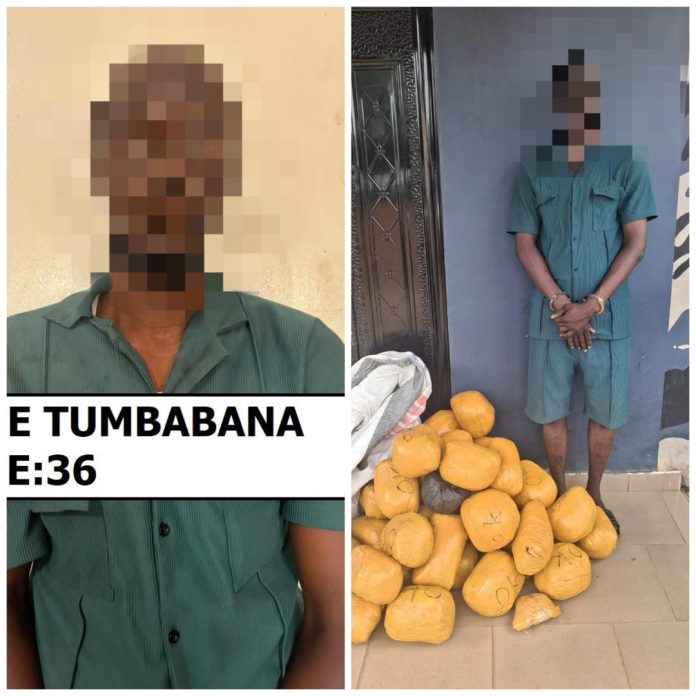
The Upper East Regional Police Command has arrested a 36-year-old man, Tumbana Ane, at Paga in the Upper East Region for allegedly possessing substances suspected to be Indian hemp and other prohibited drugs.

The suspect was arrested by the Regional Police Intelligence Directorate (PID) and the Black Cobra Team following an operation at Paga.

According to the Police, a search conducted at the suspect’s residence led to the recovery of 38 parcels of dried leaves suspected to be Indian hemp, as well as Tramadol tablets of 120mg and 250mg strengths.

The Police further said officers discovered a tunnel at the residence which they allege the suspect used to conceal the drugs to evade arrest.

Preliminary investigations, according to the Command, have also linked the suspect to the alleged operation of brothels at an illegal mining site at Wuru.

The suspect is currently in police custody and is expected to be arraigned before court.

The Upper East Regional Police Command has assured the public of its continued commitment to combating drug-related crimes and other illegal activities across the region.

The Police statement was signed by Chief Inspector Abdul-Raman Sumaila, Public Affairs Unit of the Upper East Regional Police Command.

A1Radio | 101.1Mhz | Joshua Asaah