
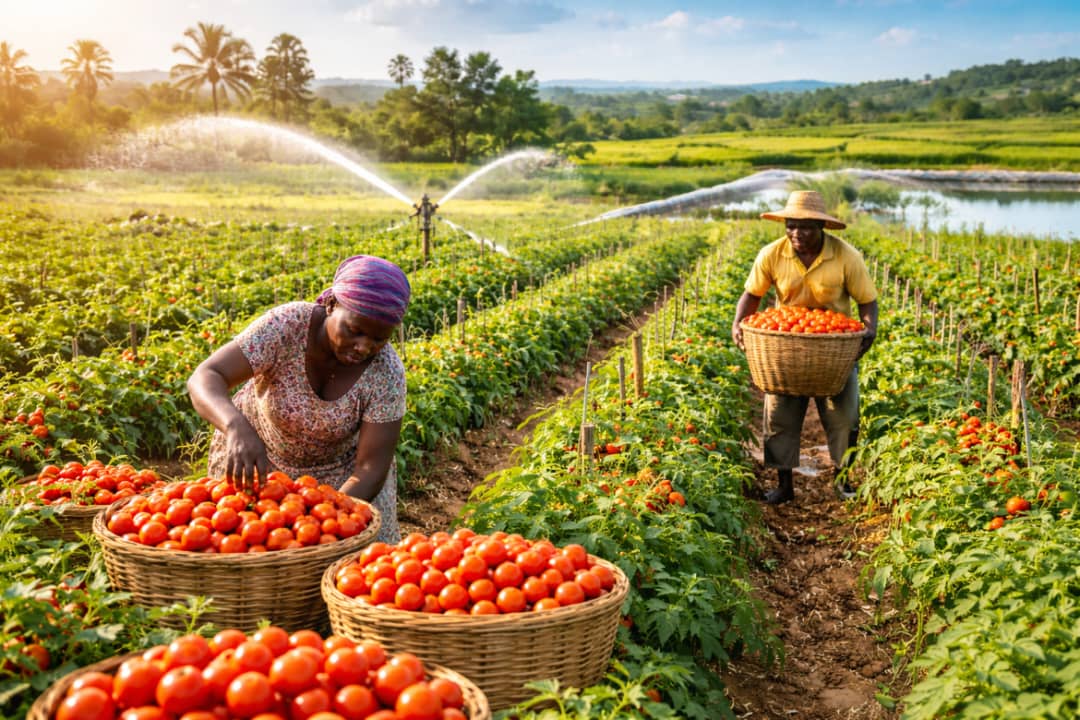
Questions are intensifying about Ghana’s reliance on cross-border agricultural supply chains and the need to fully exploit its domestic irrigation potential in the wake of the deadly ambush on Ghanaian tomato traders in northern Burkina Faso town of Titao, that killed at least seven and injuring several others. This development highlights long-standing gaps in farming infrastructure that date back to the nation’s early post-independence era.
Reports confirm that multiple Ghanaian traders were killed during a recent attack in Burkina Faso while sourcing tomatoes, underscoring the dangers of insecure regional trade routes and the vulnerability of Ghana’s food supply system. The incident underscores the fragility of Ghana’s reliance on rain-fed and cross-border agricultural supply routes and highlights the need for resilient domestic production systems.
A Legacy of Vision, A Gap in Delivery
From the 1960s, Ghana’s first President, Osagyefo Dr. Kwame Nkrumah, championed irrigation and agro-industrialization. This vision included water infrastructure development and agro-processing facilities like the Pwalugu Tomato Factory, established to add value to local tomatoes and expand domestic food processing capacity.
Despite this historic ambition, the factory, once capable of processing large volumes of local tomatoes, has struggled for raw materials and now stands largely idle, contributing to Ghana’s continued dependence on imported or regionally sourced produce.
Harnessing Water Resources Through Infrastructure
Ghana boasts vast water resources, including renewable annual water availability far exceeding current withdrawals, yet only a fraction is used for irrigation, leaving enormous potential untapped. In this context, strategic irrigation infrastructure in northern Ghana, such as the Vea and the Tono Dams, once served as hubs for a self-sufficient and secured agricultural economy including tomatoes. Revitalizing and expanding such irrigation systems in the Northern Region, Upper East Region and Upper West Region align with that historic vision of our founding Father, while mitigating the risks associated with insecure cross-border commerce.
The planned Pwalugu Multipurpose Dam on the White Volta River is among the country’s most ambitious irrigation and multipurpose water storage projects. When completed, it is expected to support approximately 25,000 hectares of irrigated agriculture, expand food production, generate hydroelectric and solar power, and provide drinking water to surrounding communities.
However, progress has been slow, and critics argue the project, envisioned to be transformational, has yet to deliver tangible benefits on the ground.
Strengthening Agriculture, Trade, and Security
Irrigation schemes such as the Vea Dam and Tono Dam over the years have demonstrated how reliable water access can extend growing seasons and diversify crop production across the Upper East Region and neighboring areas. By scaling such infrastructure, Ghana can boost production of staples and high-value crops like tomatoes, rice, onions, and peppers year-round. Such schemes can reduce dependency on perilous and distant trading routes into insecure regions, support agro-industrial facilities such as tomato processing plants, increasing local jobs and economic value. Enhance food security and reduce volatile price shocks linked to disrupted border commerce
Irrigation is not simply an agricultural objective, it’s foundational to economic resilience, community safety, and national stability.
The recent tragedy in Burkina Faso has sharpened focus on the urgent need for a fully realized irrigation strategy that turns Ghana’s water wealth into reliable agricultural output and secure commercial pathways.
About the Author
George Agana Awuni is an Assistant Research Professor at Mississippi State University. He holds a PhD in Life Sciences from Mississippi State University, an MSc in Plant Sciences from Tuskegee University, and a BSc in Natural Resources Management from Kwame Nkrumah University of Science and Technology.
Before pursuing further studies in the United States, he served three terms as an elected Assemblymember for Gowrie in the Bongo District Assembly. He previously worked with the Fisheries Commission in Ghana’s Upper East Region and has over 10 years of collaborative soybean research experience with the Savanna Agricultural Research Institute (SARI) through the Mississippi Agricultural and Forestry Experiment Station (MAFES).
Disclaimer: The views and opinions expressed in this article are those of the author and do not necessarily reflect the official policy, position, or editorial stance of this publication.