
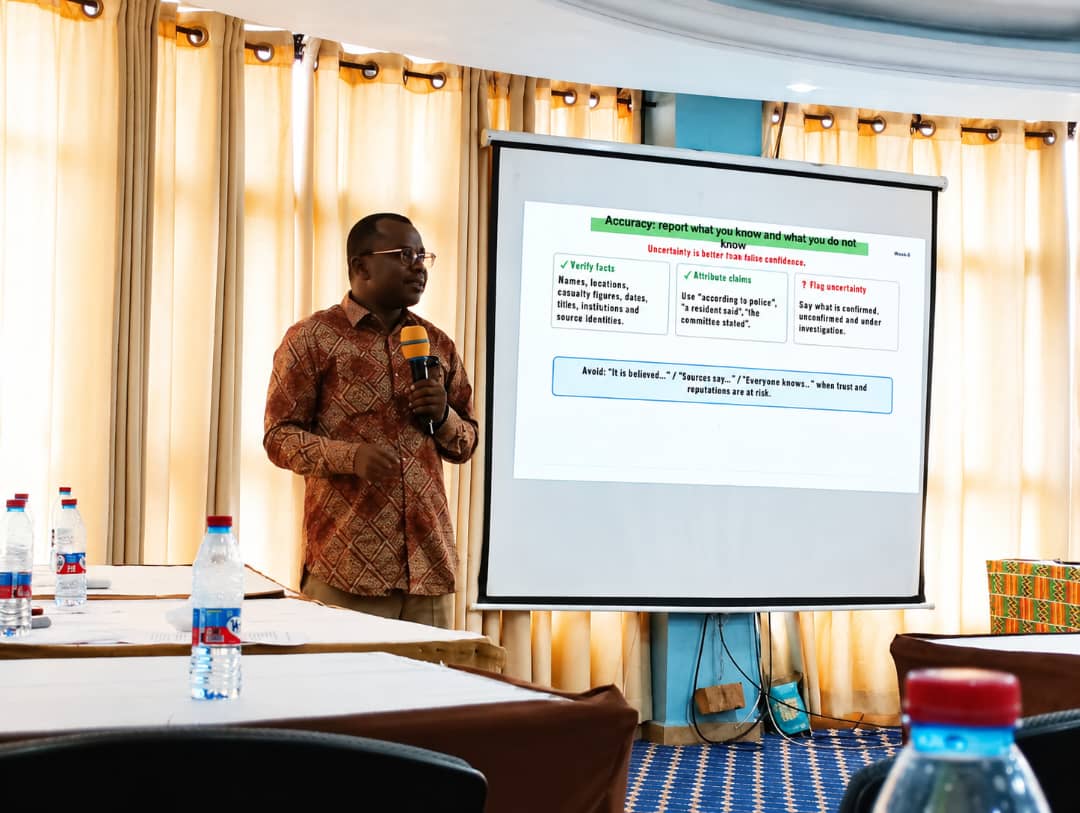
Journalists have been urged to prioritise accuracy and professional ethics over the race to break news, particularly when reporting on conflicts and other sensitive issues that could heighten tensions within communities.
The call was made by Prof. Eliasu Mumuni, lead facilitator of a conflict-sensitive reporting and fact-checking workshop organised by FactSpace West Africa in partnership with UNICEF and supported by UNESCO through the IPDC EMBRACE Project.
The two-day training brought together about 30 journalists from the Upper East Region to strengthen their knowledge of fact-checking, ethical journalism and responsible reporting in conflict-prone communities.
Speaking in an interview, Prof. Mumuni said the programme was designed to refresh journalists’ understanding of the ethical principles that guide the profession and reinforce the importance of responsible reporting in promoting peace.
“The main objective was to take participants through the principles and ethics of journalism and remind them that reporting professionally and in a balanced manner, especially in difficult situations, really matters,” he said. “A journalist’s voice carries weight and influences society, so every report must be measured and guided by professional standards.”
Prof. Mumuni said journalists occupy a strategic position in generating and disseminating information and therefore have a responsibility to ensure their reporting does not inflame already fragile situations.
He said the training also explored practical ways journalists can help de-escalate tensions when false or misleading information circulates on traditional and digital media platforms.
“We discussed the importance of slowing down, verifying information thoroughly and following ethical processes before publishing. Those steps help reduce tension and contribute to sustaining the peace we currently enjoy,” he said.
Addressing the pressure to publish quickly in the digital age, Prof. Mumuni acknowledged that competition among media organisations often encourages haste but warned that credibility should never be sacrificed for speed.
“Verification today is much faster than many people think. Most technical verification processes can be completed quickly online. The delays usually come when journalists have to seek confirmation from institutions or other stakeholders,” he said.
He encouraged journalists to build their reputations on reliability rather than being the first to publish, stressing that maintaining public trust should remain the profession’s highest priority.
“The delay in sharing information is not the issue. What matters is whether the information is credible and reliable. If people trust your newsroom, they are prepared to wait because they know that when your report comes, it has been properly verified,” he said.
Prof. Mumuni expressed confidence that participants would apply the knowledge gained during the training to promote ethical journalism and help curb the spread of misinformation and disinformation.
As part of the workshop, participants also developed messages for an interactive voice messaging system aimed at combating misinformation and disinformation in local languages across communities.
A1 Radio | 101.1 MHz | Gerard Asagi | Bolgatanga