Home Blog Page 9

Paga Youth Movement demands apology over alleged derogatory remarks about Paga

0

The Paga Youth Movement (PAYOM) has demanded the withdrawal and public apology of Mr. Tekyi Ahin, Manager of Aduana Football Club, over comments it says were derogatory towards Paga and Northern Ghana.

The demand follows remarks attributed to Mr. Ahin during a radio discussion on Space FM in Sunyani, which were subsequently rebroadcast and circulated on other media platforms.

According to PAYOM, a news card published by 90Plus Sports quoted Mr. Ahin as saying: “Dede Ayew should invest his money in goat farming in Paga – football is about relationships!”

The youth group said it found the statement offensive and unacceptable, particularly because it referenced Paga in an argument over Ghanaian football legend Dede Ayew’s reported interest in the presidency of the Ghana Football Association (GFA).

While acknowledging Mr. Ahin’s right to express an opinion on football administration and the GFA presidency, PAYOM said it objected to what it described as the disparaging manner in which Paga and Northern Ghana were invoked.

In a statement signed by its Chairman, Wenawome Aborah Duriyem, PAYOM said Paga is a community with a rich history and is home to entrepreneurs, professionals, farmers, academics, public servants, business leaders and young people contributing to Ghana’s development.

The group argued that using “goat farming in Paga” as a reference for where Dede Ayew should invest his money reinforces what it described as an unfortunate stereotype that Northern Ghana is suited only to agriculture and livestock, while positions of influence and national leadership belong elsewhere.

PAYOM rejected that characterization, pointing to the contributions of people from Northern Ghana to Ghana’s political, academic, business, sporting, cultural and public-service history.

The statement cited former Vice President Aliu Mahama, President John Dramani Mahama and former Vice President Dr Mahamudu Bawumia as examples of Northerners who have occupied some of the country’s highest political offices.

The group, however, stressed that its objection was not to goat farming or agriculture.

“PAYOM wishes to make it clear that it has nothing against goat farming. Farming is dignified work, and livestock production is an important part of Ghana’s economy,” the statement said.

It said its concern was the context in which the reference to goat farming in Paga was made.

PAYOM further highlighted Paga’s tourism, cultural and historical significance, including the Paga Crocodile Pond, Pikworo Slave Camp and the community’s role in cross-border commerce and Ghana’s relationship with Burkina Faso.

The group also expressed concern that the remarks were directed at Dede Ayew, whose family, it said, has made significant contributions to Ghanaian football.

It referenced the career of Dede Ayew’s father, Abedi Pele, describing him as one of Ghana’s most celebrated footballers, and said the Ayew family forms part of Ghana’s football heritage.

PAYOM maintained that disagreements over Dede Ayew’s suitability to lead the Ghana Football Association should be based on issues such as competence, vision, integrity, experience, relationships and stakeholder confidence rather than geography.

The group said football should unite Ghanaians across regions and urged football administrators to be mindful of public statements that could reinforce regional stereotypes or create divisions.

Consequently, PAYOM has called on Mr. Ahin to immediately withdraw the statement referring to Dede Ayew investing his money in goat farming in Paga, publicly apologise to the people of Paga, and extend the apology to the people of Northern Ghana.

The group stressed that its demand was not an attack on Aduana FC, its supporters, the people of Dormaa or the Bono people, but rather what it described as a demand for respect. PAYOM reaffirmed its commitment to peace, unity and the development of Ghanaian football.

A1 Radio | 101.1Mhz | Joshua Asaah
“We had no hesitation supporting GJA Awards because of journalists’ role in development” – MyTurn, Lesken Enterprise

0

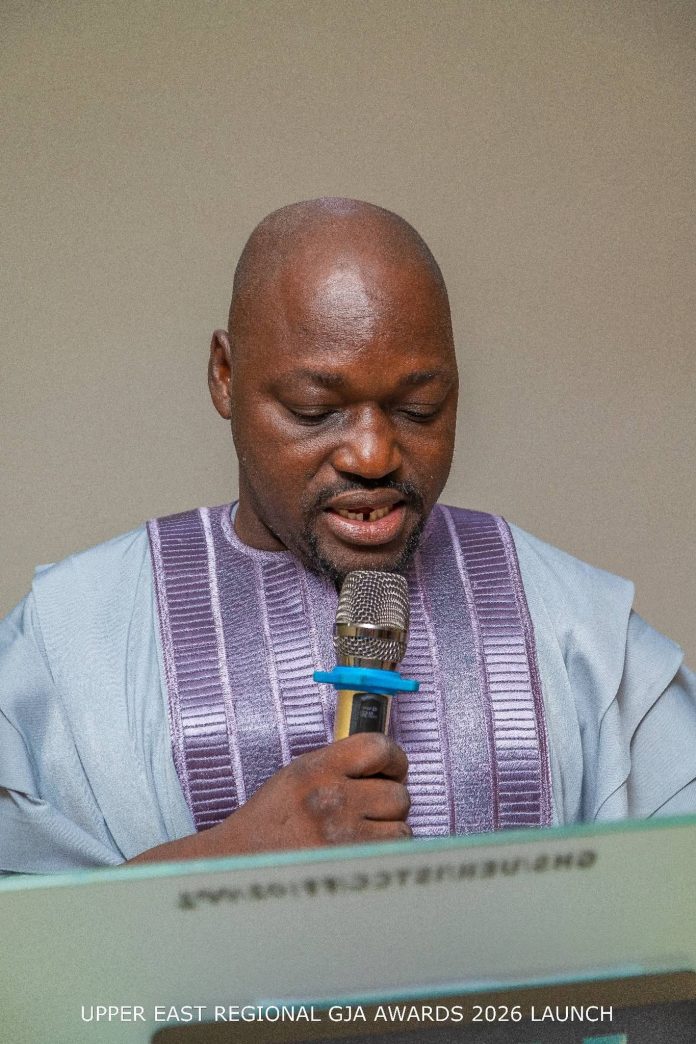
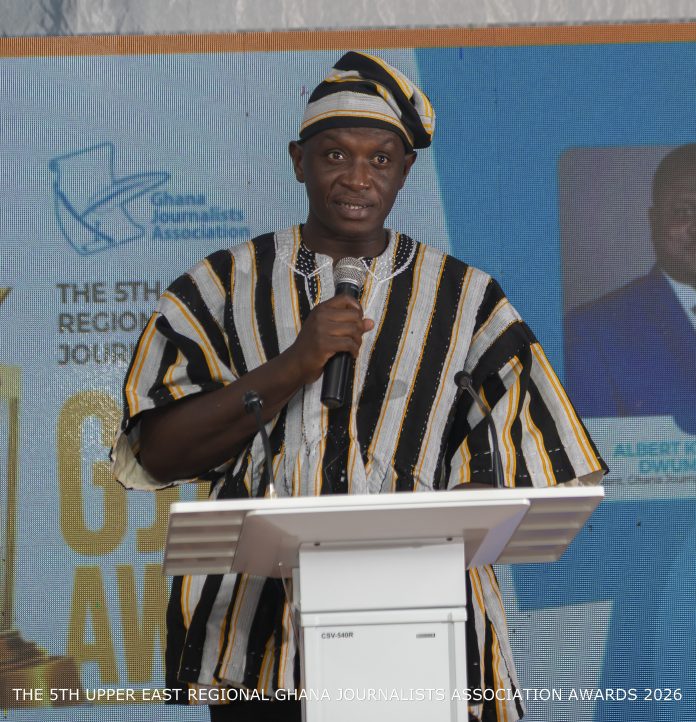
MyTurn Limited and Lesken Enterprise Limited have reaffirmed their commitment to supporting journalism in the Upper East Region, saying journalists play a critical role in advancing development and holding duty bearers accountable.

The two companies, which served as headline sponsors of the 5th Upper East Regional Ghana Journalists Association (GJA) Awards, said their decision to support the ceremony was driven by the significant contribution of the media to the development of the region.

Delivering a speech on behalf of the two companies at the awards ceremony held on Friday last week, Donald Yeribu said the media remained an important partner in efforts to project development and address issues affecting communities across the region.

He said the companies, whose roots are deeply embedded in the Upper East Region, considered supporting the awards a responsibility and therefore had no hesitation in backing the event.

“The role of journalists in our societies cannot be over-emphasized, and very much so in our diverse region. The decision to support this year’s event came without hesitation, considering the enormous contribution journalists make in our common quest to project the development of the Upper East Region,” he said.

Mr. Yeribu said journalists contribute to development by informing the public, bringing attention to issues affecting communities and providing a platform for citizens whose concerns may otherwise go unheard.

He urged journalists in the region to remain committed to their professional mandate and continue to serve as a source of reliable information for the public.

“We can only therefore urge you not to renege on your mandate to reliably inform the public, hold people in power accountable, fight disinformation, and most importantly, continue to give a voice to the marginalized,” he said.

The awards ceremony was held under the theme “Beyond the Headlines: The Media’s Role in Promoting Water, Sanitation and Hygiene (WASH) for Safe Motherhood and Quality Health Care.”

The theme placed emphasis on the role of the media in highlighting water, sanitation and hygiene challenges and their implications for maternal health and the quality of healthcare delivery.

The ceremony ended with Moses Apiah of A1 Radio emerging as Journalist of the Year, while Gladys Apuweni of GBC-URA Radio was named Female Journalist of the Year. David Azure of A1 Radio was also honoured as Most Promising Journalist of the Year.

A1 Radio | 101.1Mhz | Joshua Asaah
Gambibgo chief appeals for advanced teacher training college to strengthen STEM education

0

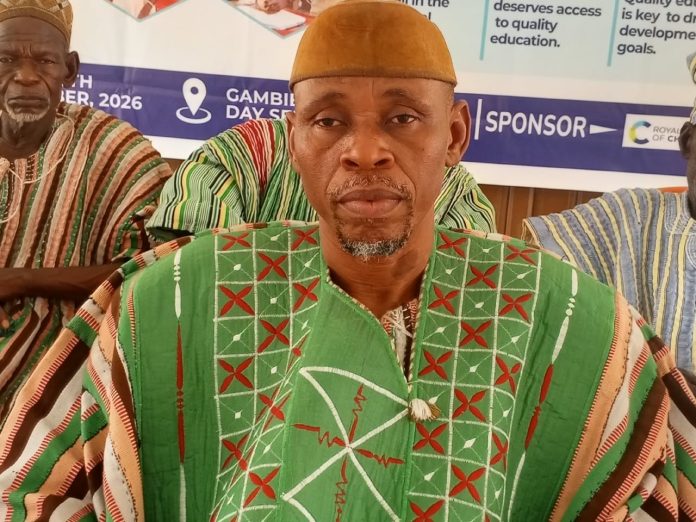
The Chief of the Gambibgo Traditional Area, Naba Sayeed Akolmolga Anon-Egra Sadik, has appealed to the Ministry of Education to support the establishment of an advanced teacher training college in Gambibgo, with a focus on science, technology and emerging fields such as artificial intelligence.

He said the proposed institution would provide teachers with specialised training to improve the quality of teaching and learning while equipping them with skills relevant to changing educational and technological demands.

The chief made the appeal during a practical chemistry training programme for teachers at Gambibgo Senior High School in the Upper East Region.

According to him, the proposed college should prioritise Science, Technology, Engineering and Mathematics (STEM), artificial intelligence and other emerging areas to strengthen teachers’ capacity to deliver practical and relevant education.

He argued that improving teacher education was essential to preparing students for opportunities in science, technology and innovation.

Naba Sadik also stressed that the benefits of teacher training programmes should extend beyond participating teachers to students in their respective schools.

He therefore urged education stakeholders to ensure that teachers apply the knowledge and practical skills acquired through training programmes in their classrooms.

The chief further called for sustained support for initiatives that expose teachers and students to practical science, particularly chemistry, and emerging technologies.

He said Ghana and other African countries must invest more in science and innovation to develop the human resources needed to compete in a rapidly changing global economy.

According to him, although Africa must preserve its history and learn from past achievements, the continent must also devote greater attention to scientific and technological advancement.

He cautioned against concentrating excessively on past achievements while other parts of the world continue to make progress in science and technology.

Naba Sadik expressed hope that the Ministry of Education would consider the proposed college as part of broader efforts to improve teacher education and strengthen Ghana’s human capital development.

He maintained that sustained investment in science education and teacher training would help prepare young people to contribute to national development.

A1 Radio | 101.1 MHz | Moses Anaba Azubire | Bolgatanga

Public school students disadvantaged by lack of practical science facilities – KNUST professor

0

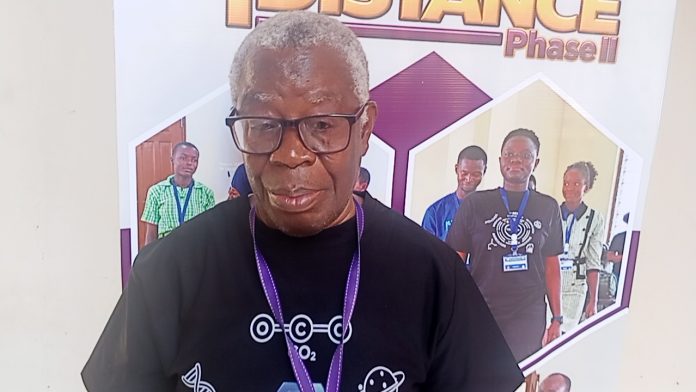
Professor Johannes Akpabla Mawuli Awudza of the Kwame Nkrumah University of Science and Technology (KNUST) has raised concerns about inequalities in access to practical science education in Ghana, warning that students in poorly resourced public schools are being expected to compete with their counterparts in better-equipped private schools despite significant differences in learning conditions.

He said many public schools, particularly those in deprived communities, lack basic laboratory facilities and materials needed for practical science lessons, leaving students at a disadvantage when writing national examinations and seeking admission to higher educational institutions.

Prof. Awudza raised the concerns during a practical science training programme for teachers at Gambibgo Community Day School in the Upper East Region.

According to him, while some private and international schools have the resources to provide students with regular practical lessons, many public schools struggle to obtain even basic materials for scientific experiments.

He described the disparity as unfair, particularly because students from both categories of schools are assessed through the same examination system.

“We have these two categories of students, and all of them have to write the same examination. Apart from writing the same examination, all of them have to progress into higher education,” he said.

Prof. Awudza questioned how students in deprived schools could be expected to compete fairly when they lack opportunities to develop the practical skills and understanding required for science education.

He said the situation was particularly concerning in underserved communities in Northern and Western Ghana, where inadequate facilities and teaching resources continue to affect science education.

The KNUST lecturer therefore urged the Ghana Education Service and other education stakeholders to prioritise the provision of basic laboratory equipment and teaching materials to improve practical science education in public schools.

He, however, maintained that effective practical science teaching did not always require expensive laboratory equipment.

According to him, teachers could use affordable and locally available materials to demonstrate scientific concepts and conduct experiments that would improve students’ understanding of science.

“We have told them what to do. We have done experiments that are practical. We do not need much money,” he said.

He encouraged science teachers to adopt innovative teaching methods while calling on education authorities to ensure that schools have the basic resources required for effective teaching and learning.

Beyond the challenges facing science education, Prof. Awudza also called for increased investment in educational infrastructure, learning materials and teacher welfare, describing education as essential to Ghana’s development.

“Without education, our minds would be shut. Without education, our people would draw back to the ancient times,” he said.

He acknowledged government investments in school infrastructure, including the construction of Community Day Senior High Schools, commonly known as E-Blocks, but said providing buildings alone was insufficient to guarantee quality education.

According to him, schools must also be equipped with the necessary learning materials and supported by teachers who are adequately motivated to deliver effective lessons.

Prof. Awudza expressed concern about disruptions to teaching and learning resulting from teacher absence, recounting an encounter at a school where he found a student studying alone in the library.

“It is sad that you come to a school like this, with the facilities that they have provided, and teachers are not in the classroom,” he said.

He consequently urged the government and teacher unions to engage in constructive dialogue to resolve outstanding concerns affecting teachers and minimise disruptions to academic activities.

The professor also called for stronger collaboration between government and local communities in the management of educational facilities.

He said communities should take greater responsibility for protecting and maintaining school infrastructure provided in their areas to ensure that such investments continue to benefit learners.

Prof. Awudza maintained that improving educational outcomes would require sustained attention to infrastructure, practical learning resources, teacher welfare and community participation.

A1 Radio | 101.1 MHz | Moses Anaba Azubire | Bolgatanga

BTU’s smart flood monitoring system wins 2026 Women in Engineering competition

0

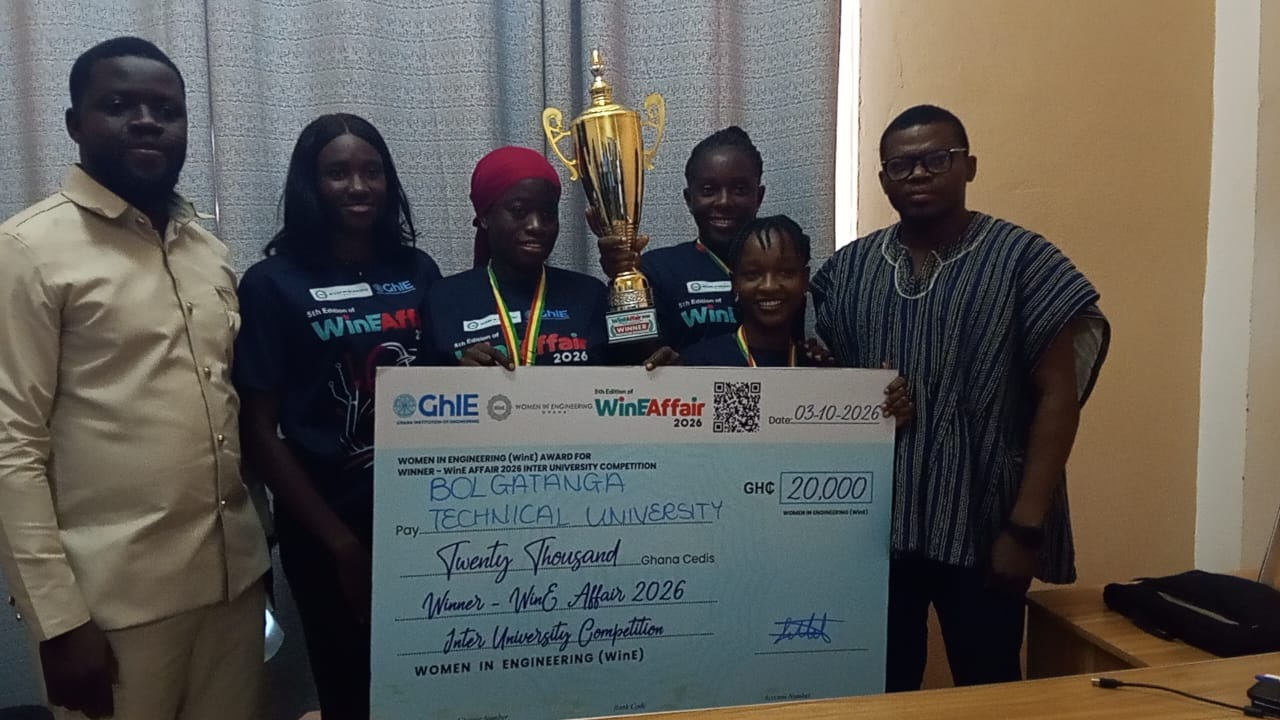
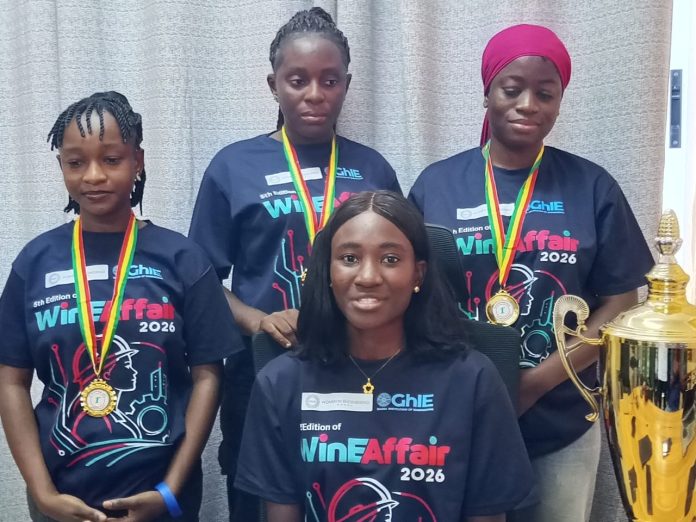
Bolgatanga Technical University (BTU) has emerged winner of the 2026 Women in Engineering (WiNE) Affair competition after developing a smart emergency communication system designed to detect floods and help emergency responders locate people in danger.

The university beat 18 other participating tertiary institutions, including Kwame Nkrumah University of Science and Technology (KNUST), University for Development Studies (UDS) and the University of Ghana, to claim the top prize.

The competition, organised under the Ghana Institution of Engineering (GhIE), was held at Ho Technical University and brought together female engineering students to develop innovative solutions to challenges affecting communities.

BTU received a trophy and a cash prize of GH¢20,000 for its winning project, Smart Emergency Communication System with Flood Monitoring.

The innovation is designed to automatically detect flooding and send emergency alerts, including GPS location information, to assist agencies such as the National Disaster Management Organisation (NADMO) and the Ghana National Fire Service in responding to emergencies.

Speaking at BTU after the team’s return from the competition, Aurelia Ayamdor, a lecturer in the Department of Electrical and Electronics Engineering who led the team, explained that participating institutions were tasked with developing solutions to real problems affecting communities.

“For the Wine Affair 2026, projects were given to the various universities to come out with a solution for a problem to be solved in the community. And we know that recently there was flooding in various regions. So our team came out with a solution, which is a smart emergency communication with a flood monitoring system,” she said.

According to her, the system was developed in response to recurring floods in Ghana, which have caused deaths, displaced residents and damaged properties in several communities.

She explained that the device could help emergency responders identify the locations of people trapped during flooding.

“This device can help save lives of people, those who are trapped during flooding. So it’s a communication system that communicates to respondents, for example the fire service, NADMO, in order to come to save the lives of the people. This system has a GPS location where they are able to locate the victims to save their lives,” she said.

Madam Ayamdor attributed the team’s success to its determination and preparation ahead of the competition.

She urged university management to invest more in practical engineering activities, particularly initiatives that encourage women to develop technical skills and pursue careers in engineering.

“Management should invest more in these kind of activities so that they are able to develop more of their skills, especially women in engineering, because ladies in engineering is something that is difficult. It’s not easy,” she added.

The Dean of BTU’s School of Engineering, Eng. Dr George Alexander Dordah, said the achievement demonstrated the ability of students to apply classroom knowledge to practical challenges confronting society.

“This competition was all about innovation, how to innovate to solve problems in our society. What this means for us goes beyond just winning. It demonstrates that our students can apply the knowledge we are giving them here to develop, innovate, and solve problems in society,” he said.

Dr Dordah said the project was particularly relevant given the recurring flooding experienced in parts of Ghana, including communities in Northern Ghana affected by the spillage of the Bagre Dam and flood-prone areas in Accra.

He explained that the system was designed to detect flooding and transmit alerts without requiring someone to manually activate it.

“It is important that we are able to early detect these floods. With this device, it’s very easy. The good thing about it is that you don’t need somebody triggering it. Once it senses the flood, it goes ahead to send signals and indicate where you can actually locate whoever is in a problem. And so it becomes easy to save people,” he said.

He said the university would continue to emphasise practical training that enables students to develop solutions to challenges facing communities and industry.

The Students’ Representative Council (SRC) President, Kenneth Atonka Nsoyine, also congratulated the team, describing the achievement as a reflection of the students’ dedication and teamwork.

“Your achievement is a true reflection of the hard work, dedication, discipline and determination of the students of Bolga Technical University. You have represented BTU with pride and excellence, proving that when talent is supported by dedication and teamwork, great things are possible,” he said.

A1 Radio | 101.1 MHz | David Azure | Bolgatanga

Kacstone Records MD calls for more private investment in Upper East tourism

0
The Managing Director of Kacstone Records, Wenawome Duriyem Aborah, has urged business owners and individuals with financial resources in the Upper East Region to invest in culture, entertainment and tourism to create employment opportunities for young people.

He said the region’s cultural heritage and tourism potential could support a range of businesses if investors were willing to look beyond immediate financial returns and invest in infrastructure, skills development and the promotion of local attractions.

Speaking on A1 Radio’s programme, Turning Culture into Employment: Adapting the Local Way, Mr Aborah said Northern Ghana’s diverse cultural traditions were not receiving adequate exposure because of limited investment, inadequate infrastructure and poor presentation.

“It is about time we ourselves package ourselves and throw it to the world,” he said.

Mr Aborah, who is also Chairman of the Paga Youth Movement, said he had invested in LED screens, sound systems and other event equipment to help improve the quality of events organised in the Upper East Region.

According to him, the investment was partly intended to reduce the need for event organisers to bring equipment and technical services from Accra and other parts of the country.

He argued that the difference between events organised in Northern Ghana and those held in cities such as Accra and Kumasi was often not the quality of the cultural content but the equipment, branding and presentation.

Mr Aborah said he had also trained young people in Paga to operate and manage the equipment, providing them with skills and opportunities to earn income through the events industry.

He acknowledged that investments in culture and entertainment might not always produce immediate financial returns but said their potential to create employment and develop the region should encourage more people to participate.

“I encourage many more people to invest into it,” he said.

He urged individuals with resources to consider how their investments could benefit communities and create opportunities for young people beyond their immediate families.

“Don’t just look at the immediate benefit that you want to benefit with your family. But create avenues for other youth to emulate from you,” he stated.

Mr Aborah also called for stronger collaboration among communities in the Upper East Region to promote their cultural identities and traditions.

He said cultural differences should be used to encourage tourism and strengthen relationships among communities rather than become sources of division.

According to him, organising events that bring together different cultural groups could help residents appreciate one another’s traditions while creating opportunities for traders, entertainers and other businesses.

He also stressed the importance of preserving local languages and traditions as part of efforts to develop a distinctive tourism identity for the region.

Mr Aborah cited the Volta Region as an example of an area he believes has made deliberate efforts to promote its tourism identity, urging stakeholders in the Upper East Region to adopt a similarly coordinated approach.

He further proposed developing tourism activities around the region’s landscapes and seasonal characteristics, including events during the rainy and dry seasons.

Such initiatives, he argued, could attract visitors at different times of the year and provide additional business opportunities for local communities.

Mr Aborah maintained that the region’s culture and tourism attractions should be treated as economic assets capable of generating income and employment rather than resources preserved solely for occasional celebrations.

A1 Radio | 101.1 MHz | Moses Apiah | Bolgatanga

Upper East losing tourism opportunities over neglected heritage sites – Aborah

0

The Managing Director of Kacstone Records, Wenawome Duriyem Aborah, has raised concerns about the neglect of historical and cultural sites in the Upper East Region, warning that the situation is depriving communities of potential tourism revenue and employment opportunities.

He cited Karimenga Hill, which he said has a safe house reportedly used by Ghana’s first President, Dr Kwame Nkrumah, as one of the historical attractions that could be developed to attract visitors but has been allowed to deteriorate.

Mr Aborah, who is also Chairman of the Paga Youth Movement, said the site could be restored and equipped with facilities to help visitors appreciate its historical significance while creating business opportunities for surrounding communities.

According to him, several other locations across the Upper East Region have historical and cultural significance but remain largely undeveloped because of inadequate investment and the absence of deliberate plans to promote them as tourism destinations.

He argued that preserving such sites should go beyond protecting their historical value to creating economic opportunities for residents, particularly young people.

“Tourism should be an employable entity,” he said.

Mr Aborah made the observations following his participation in a tourism industry engagement in Lesotho, where he said he witnessed efforts to develop heritage sites into organised attractions that generate revenue.

He explained that some tourism destinations in Lesotho were supported by facilities for entertainment, conferences and other activities that encouraged visitors to spend money within the local economy.

He believes the Upper East Region could adopt similar approaches by identifying historical landmarks, preserving their significance and developing complementary services around them.

Mr Aborah also raised concerns about the management of some heritage sites, arguing that treating culturally significant locations solely as private family properties could limit opportunities for their development.

He called for appropriate arrangements involving traditional authorities, communities, government agencies and private investors to ensure that such sites are preserved and developed for public benefit.

Beyond Karimenga Hill, Mr Aborah mentioned the historic mosque at Pusiga as another attraction he believes has not received sufficient attention to realise its tourism potential.

He said the region’s historical landmarks, cultural traditions and community histories could attract both domestic and international visitors if properly documented, preserved and promoted.

Mr Aborah therefore urged stakeholders to develop a coordinated approach to tourism that would protect the region’s heritage while creating sustainable livelihoods for communities.

A1 Radio | 101.1 MHz | Moses Apiah | Bolgatanga

Stop treating festivals as mere celebrations, turn culture into jobs – Aborah

0

The Managing Director of Kacstone Records, Wenawome Duriyem Aborah, has called for deliberate investment in tourism and cultural activities in the Upper East Region to create sustainable employment opportunities, particularly for young people.

He said the region’s tourism attractions, festivals and cultural heritage could support businesses in hospitality, transportation, food services, entertainment and handicrafts if developed into a structured industry.

Mr Aborah, who is also Chairman of the Paga Youth Movement, argued that tourism should be treated as an economic opportunity rather than an activity centred mainly on festivals and occasional visits to tourist attractions.

“Tourism is a basket of employment that gives a value chain,” he said.

According to him, the economic benefits of tourism extend beyond the operators of tourist attractions to businesses and individuals providing services to visitors.

He said developing the sector could create opportunities for young people who are struggling to secure formal employment, particularly in communities with established tourism attractions.

Mr Aborah made the remarks following his participation in a tourism industry engagement in Lesotho, where he observed efforts to position tourism as a source of employment and economic growth.

He said the experience demonstrated the importance of deliberately developing the skills of people living around tourist destinations and supporting them to take advantage of business opportunities.

Mr Aborah believes Ghana, particularly the Upper East Region, could adopt similar approaches by providing training and other forms of support to people interested in operating tourism-related businesses.

He said such interventions should not be restricted to students or people in formal education but should also target unemployed young people and residents of communities surrounding tourist attractions.

According to him, training people in hospitality, customer service, entertainment, handicrafts and other tourism-related activities could help communities derive greater economic benefits from their cultural and natural resources.

He also called for stronger collaboration among government agencies, traditional authorities, private investors and local communities to develop the sector.

Mr Aborah argued that government alone could not provide employment for everyone and that private investment and community participation would be essential to expanding opportunities in tourism.

He urged stakeholders to develop activities and events around the Upper East Region’s distinctive landscapes, cultural traditions and seasonal attractions to encourage more visits and create business opportunities.

He maintained that tourism destinations should be developed into economic assets that support livelihoods throughout the year rather than places visitors merely tour before leaving.

A1 Radio | 101.1 MHz | Moses Apiah | Bolgatanga

Invest in journalists, stop treating media scrutiny as attacks – Dr Apaak

0

Deputy Minister for Education Dr Clement Abas Apaak has called on media organisations to invest in journalists and urged public institutions to stop treating legitimate questions from reporters as attacks.

He said producing credible investigative and development journalism requires adequate resources, access to information and strong editorial oversight, while public institutions must be prepared to account for their decisions and use of public resources.

Speaking at the 5th Upper East Regional Ghana Journalists Association (GJA) Awards in Bolgatanga, Dr Apaak said journalists could not be expected to produce quality accountability stories without the necessary support from their newsrooms.

“If we want stronger investigative and development journalism out of the Upper East Region, we must invest in the journalists who are expected to produce it,” he said.

According to him, journalists need sufficient time, transport and access to information to investigate issues thoroughly, while editors must be prepared to question the evidence supporting their reports.

He said editors should routinely challenge reporters to establish the sources of figures, seek responses from people or institutions mentioned in their stories and verify claims before publication.

Dr Apaak argued that such editorial scrutiny was necessary to protect the credibility of journalism and strengthen public confidence in media reporting.

He also urged public institutions to respond constructively when journalists raise questions about public services, development projects and the management of public resources.

“A journalist’s question is not automatically an attack,” he stated.

The Deputy Minister said questions about why a health facility lacks water or why a development project has stalled should be treated as legitimate accountability concerns rather than attempts to discredit the institutions responsible.

“Where the media gets something wrong, correct the record. But where the question is fair, answer it. That is how accountability works,” he said.

Dr Apaak maintained that public institutions exist to serve citizens and therefore have a responsibility to provide credible answers when questions are raised about their performance.

He also reminded journalists that their responsibility to hold institutions accountable must be matched by a commitment to accuracy, fairness and verification.

According to him, reporters must give individuals and institutions opportunities to respond to allegations and correct mistakes when they occur.

The Deputy Minister further urged journalists in the Upper East Region to pursue sustained reporting on issues affecting communities, particularly in health, education, agriculture, water and sanitation.

He said journalists should not abandon stories after reporting initial developments but should continue examining whether promises have been fulfilled and public resources have produced the intended results.

“Do not leave the story at the headline. Stay with the issue. Follow the promise, follow the money, follow the people affected,” he said.

Dr Apaak was the Special Guest of Honour at the 5th Upper East Regional GJA Awards, which recognised journalists for their contributions to public-interest reporting and development in the region.

A1 Radio | 101.1 MHz | Moses Apiah | Bolgatanga

Education Ministry warns schools against unauthorised fees, diversion of students’ food

0

The Ministry of Education has warned school authorities across Ghana to stop charging unauthorised fees and diverting food intended for students, describing the reported practices as a breach of public trust.

Deputy Minister for Education Dr Clement Apaak said the Ministry had received troubling reports of some school managements imposing unapproved charges on parents and diverting food supplies meant for students.

Speaking at the 50th anniversary celebration of Zamse Senior High/Technical School (ZAMSTECH) in Bolgatanga, Dr Apaak said such practices were unacceptable and must stop.

“No parent should be asked to pay what was never sanctioned. No child should go hungry because food bought for their plate ended up somewhere else,” he said.

The Deputy Minister warned that school managements found engaging in such practices should not expect the Ministry to overlook them.

“Where this is happening, it must stop, and school managements across this country should hear this as a clear warning, not a suggestion,” he stated.

Dr Apaak, however, clarified that his comments were not directed at ZAMSTECH, its Board or Management, but reflected broader concerns about reports reaching the Ministry from schools across the country.

He said parents should not be compelled to pay fees that had not been approved by the appropriate authorities, while food and other resources provided for students must be used for their intended purposes.

According to him, accountability in education should extend beyond academic performance and infrastructure development to include the management of funds, food supplies and other resources entrusted to school authorities.

He stressed that resources provided by the government and parents were intended to support students’ education and welfare and should not be misappropriated.

The Deputy Minister also called on school authorities, parents, traditional leaders, alumni and other stakeholders to play their respective roles in ensuring that schools provide quality education in a safe and supportive environment.

Dr Apaak delivered the warning during ZAMSTECH’s Golden Jubilee celebration, held under the theme, “Empowering Minds and Shaping the Future: The Role of Stakeholders.”

A1 Radio | 101.1 MHz | Moses Apiah | Bolgatanga